


Westphal specific gravity balance
Date1902-1925
Inventory Number3826
ClassificationSpecific Gravity Balance
Subject
Supplier
Scientific Materials Company
1902 - 1925
Cultural Region
Place of Origin
Dimensions21.2 x 20.5 x 6 cm (8 3/8 x 8 1/16 x 2 3/8 in.)
case: 8.2 x 23.8 x 15.5 cm (3 1/4 x 9 3/8 x 6 1/8 in.)
case: 8.2 x 23.8 x 15.5 cm (3 1/4 x 9 3/8 x 6 1/8 in.)
Material
Accessorieshook; riders (4); immersion thermometer with hook in wooden holder
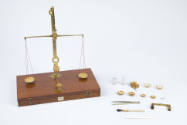
DescriptionAn asymmetrical balance consisting of a brass stand with a round base that holds a brass platform, curved into a semicircle on one of its ends and with its other end acting as a pivot for a balance beam. The beam is asymmetrical with a long thin section extending horizontally outward having several dents with marked numbers on its top edge and a hook at its extreme end, while at its other end the beam is shorter, thicker, and forming a cylindrical weight at the extreme end on this side. It has a needle indicator on this extreme, with a similar needle extending from the curved portion of the balance platform. From the hook at the far end of the beam would hang a thick immersible glass thermometer tied to a brass hook (included) and several weight made of wire (riders) can be placed atop the balance beam on the numbered dents. One wooden holder in the case is broken.
Signedon top of case: SCIENTIFIC MATERIALS COMPANY
FunctionThis is a balance that is used to determine the specific gravity of unknown liquids without the need of intermediary calculations.
The balance is designed to be in equilibrium with the thermometer hanging from the end of the balance and immersed in water at 4 degrees Celsius, with one of the riders on the tip of the beam. When placed in a different liquid (or at a different temperature), the beam will rise or sink, and the idea is to try to restore the equilibrium by adding more riders to the beam either with (for liquids heavier than water) or without (for liquids lighter than water) the original rider that was at the tip of the beam. Each rider is 1/10 of the weight of the previous one, and the sequence of numbers in the dents that the riders are located on, in the order of their weight, can be read directly as the specific gravity of the liquid.
For an example of how it is set-up, see the following website.
The balance is designed to be in equilibrium with the thermometer hanging from the end of the balance and immersed in water at 4 degrees Celsius, with one of the riders on the tip of the beam. When placed in a different liquid (or at a different temperature), the beam will rise or sink, and the idea is to try to restore the equilibrium by adding more riders to the beam either with (for liquids heavier than water) or without (for liquids lighter than water) the original rider that was at the tip of the beam. Each rider is 1/10 of the weight of the previous one, and the sequence of numbers in the dents that the riders are located on, in the order of their weight, can be read directly as the specific gravity of the liquid.
For an example of how it is set-up, see the following website.

Georg Westphal
Date: circa 1893
Accessories: slotted wooden arm; immersion thermometer on wire with hook; two extra wires sewed to blue paper; tweezers; riders in cylindrical cardboard box (in larger box)
Object number: 3827

Fisher Scientific Company
Date: circa 1963
Accessories: Reimann thermometer-Plummet, cat. no. 2-155 No 4402 WK missing glass jar (pygnometer?); one rider
Object number: 1998-1-0090a

Beckman Instruments, Inc.
Date: circa 1960
Object number: 1998-1-0090b



Jean-Francois Wolschot
Date: date 1750
Accessories: square gold weights in box
Object number: DW0986

Giellis Joerse
Date: 1634-1654
Accessories: square weights in box
Object number: DW0987


Crosby Steam Gage & Valve Company
Date: circa 1903
Accessories: instruction manual; letter from company; one gallon can of oil (2002-1-0100)
Object number: 1998-1-1618

