




mechanical equatorial sundial
Date1675-1725
Inventory Number7881
ClassificationSundial
Subject
Maker
German
Place of Origin
Dimensions13.1 x 12 x 17.1 cm (5 3/16 x 4 3/4 x 6 3/4 in.)
thickness of plate: 0.2 cm (1/16 in.)
thickness of plate: 0.2 cm (1/16 in.)
Material
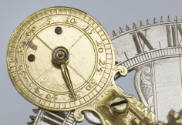
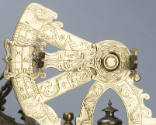
DescriptionThis mechanical equatorial sundial is fashioned of gilt and silvered brass in a Baroque style, and appears to have been made in Augsburg. The sundial has four leveling screw feet with turned silvered bases and silvered finials. The plumb-bob bracket is silvered and has a scrolling ribbon and leaf design. The bob is present. The bracket does not fold down. It is held with a nut.
The equatorial plate is silvered, engraved with acanthus leaves, and pierced. Hours are marked I-XII twice and divided every 5 minutes. The minute dial is gilt and has a single pointer. It is divided 1-60, with subdivisions every minute. Arabic numerals are used. Geared teeth on the limb of the equatorial plate engage the gear of the minute dial.
The minute dial is attached to gilt brass arm at whose opposite end there is an hour pointer. Attached at right angles to this arm, there exists a pierced, gilt brass structure with a solar declination scale. The scale has two sides. One is marked with the initials of the months and is divided every 5 days. The other is marked with zodiacal symbols and is divided every 5°. This side also has a spot and target gnomon and a pointer in an open bracket. The spot and target gnomon is silvered. They are all very fancily engraved with scrolling acanthus leaves and ribbon work.
The equatorial plate is adjustable for latitudes by means of a silvered, folding arm that sits in a notch on a gilt brass slider that is fixed in a slot in the base of the instrument by means of a nut underneath. The slider can be set for latitudes 35°-65°, subdivided every 1°.
The base is gilt brass, pierced, with scrolling acanthus leaves, and trimmed edges. The finials of the feet touch the base at roses. The underside of the base and equatorial plate are both plain, but show cracks in the casting.
There is corrosion on a rear finial.
The equatorial plate is silvered, engraved with acanthus leaves, and pierced. Hours are marked I-XII twice and divided every 5 minutes. The minute dial is gilt and has a single pointer. It is divided 1-60, with subdivisions every minute. Arabic numerals are used. Geared teeth on the limb of the equatorial plate engage the gear of the minute dial.
The minute dial is attached to gilt brass arm at whose opposite end there is an hour pointer. Attached at right angles to this arm, there exists a pierced, gilt brass structure with a solar declination scale. The scale has two sides. One is marked with the initials of the months and is divided every 5 days. The other is marked with zodiacal symbols and is divided every 5°. This side also has a spot and target gnomon and a pointer in an open bracket. The spot and target gnomon is silvered. They are all very fancily engraved with scrolling acanthus leaves and ribbon work.
The equatorial plate is adjustable for latitudes by means of a silvered, folding arm that sits in a notch on a gilt brass slider that is fixed in a slot in the base of the instrument by means of a nut underneath. The slider can be set for latitudes 35°-65°, subdivided every 1°.
The base is gilt brass, pierced, with scrolling acanthus leaves, and trimmed edges. The finials of the feet touch the base at roses. The underside of the base and equatorial plate are both plain, but show cracks in the casting.
There is corrosion on a rear finial.
In Collection(s)
Signedunsigned
ProvenanceJoseph Drecker, Aachen, Germany, before 1928; Frederik Casparus Wieder, Noordwijk, The Netherlands, 1928; D. P. Wheatland, Topsfield, MA, 1959; gift to CHSI, 1985.

John Pepys
Date: 1680-1708
Accessories: Key on cotton ribbon
Object number: 7953


N. James
Date: 1700-1725
Accessories: winding key
Object number: 7935

Jacques le Maire
Date: 1738
Accessories: case; plumb bob
Object number: 7416


Ludovicus Theodatus Müller
Date: 1750-1770
Accessories: case
Object number: 7079

Johann Martin
Date: 1670-1720
Accessories: case
Object number: 7071


George Lindsay
Date: 1724
Accessories: Winding key; box.
Object number: 1990-1-0007
See also/See also
