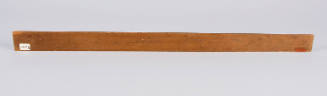
boxwood Gunter's scale
Datecirca 1720
Inventory Number5455
ClassificationGunter's Scale
Subject
Maker
English
Cultural Region
Place of Use
Dimensions0.4 × 61 × 4 cm (3/16 × 24 × 1 9/16 in.)
Material
DescriptionBoxwood rule with multiple black scales on both sides.
The front of the rule is partitioned into eight horizontal scales constituting Gunter's Scale. Each is labeled by initials on the left hand side of the rule. The initials and their meanings are as follows, from top to bottom: SR [Sines of the Rhumbs], TR [Tangents of the Rhumbs], Num [Gunter's Line of Numbers], Sin [Line of Sines], VS [Versed Sines], Tan [Tangents], Mer [Meridian Lines], EP [Equal Parts]
One edge of the back side of the scale is partitioned into 23 equal increments, each appropriately labeled with a numeral and further subdivided in tenths by small black lines. The following three additional scales are found on the back:
1. 10" Plotting Scale with diagonal lines [transverse method]
2. Plain Scale: Cho[rds], Sin[es], Rum[bs], Tan[gents], ST[angents]
3. Plotting Scale: Lea[unknown, possible leagues], Rum[bs], ML [Meridian Line], Cho[rds]
The front of the rule is partitioned into eight horizontal scales constituting Gunter's Scale. Each is labeled by initials on the left hand side of the rule. The initials and their meanings are as follows, from top to bottom: SR [Sines of the Rhumbs], TR [Tangents of the Rhumbs], Num [Gunter's Line of Numbers], Sin [Line of Sines], VS [Versed Sines], Tan [Tangents], Mer [Meridian Lines], EP [Equal Parts]
One edge of the back side of the scale is partitioned into 23 equal increments, each appropriately labeled with a numeral and further subdivided in tenths by small black lines. The following three additional scales are found on the back:
1. 10" Plotting Scale with diagonal lines [transverse method]
2. Plain Scale: Cho[rds], Sin[es], Rum[bs], Tan[gents], ST[angents]
3. Plotting Scale: Lea[unknown, possible leagues], Rum[bs], ML [Meridian Line], Cho[rds]
Signedunsigned
FunctionGunter's scale is a predecessor of the slide rule. It is used in conjunction with a set of dividers or a compass to rapidly perform various navigational, trigonometric, logarithmic, and regular arithmetic calculations. The rule can also be used to measure plane lengths and draw lines.
For a history of the Gunter's scale, its uses and components, click here.
For a history of the Gunter's scale, its uses and components, click here.
ProvenanceEdward Holyoke (Cambridge, Massachusetts); given to his son, Dr. Edward Augustus Holyoke; given to his daughter, Susannah Holyoke Ward; given to her daughter, Mary Holyoke Ward Nichols; given to her son, Andrew Nichols; given to seven of his grandchildren to own equally; David Wheatland (Topsfield, Massachusetts) purchased from Nathan P. Nichols (Hathorne, Massachusetts) January 16, 1975; donated to CHSI 1975.
Historical AttributesBelonged to Edward Holyoke (President of Harvard, 1736-1769) and purchased along with other Holyoke instruments from his descendants by David P. Wheatland.


English
Date: 1775-1800
Accessories: case contains the following nine instruments: one ivory and brass sector; one ivory and brass parallel rule; one brass protractor; two pairs of dividers, one with pen holder, pencil holder, and inking wheel (for drawing dotted line) attachments; and pen.
Object number: 5458


George Adams (I)
Date: circa 1766
Accessories: original case
Object number: DW0955

Gilson Slide Rule Company
Date: 1915-1919
Object number: 1989-1-0006

Tavella Sales Company
Date: dated 1944
Accessories: brown fabrikoid case; postmarked order form and advertisement for Mascot slide rule
Object number: DW0968

Tavella Sales Company
Date: copyright 1934
Accessories: black leather case with snap closure, instruction manual (in file)
Object number: 2003-1-0244

Tavella Sales Company
Date: copyright 1934
Accessories: instruction booklet (in filet); semicircular black fabrikoid case
Object number: 1990-4-0001