


backstaff
Date1753
Inventory Number1993-1-0011
ClassificationBackstaff
Subject
Maker
John Dupee
Cultural Region
Place of Origin
Dimensions63.6 x 34.8 x 2 cm (25 1/16 x 13 11/16 x 13/16 in.)
Material
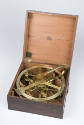
DescriptionThis is a standard English backstaff. This one, however, is missing the sighting vanes that were essential in making the altitude measurements. The small semi-circle scale is graduated from 0-65°, divided in degrees, while the large graduated limb has two distinct scales: 65°-90° and 0-25°, the latter divided every 5'. Diagonals are used for precision readings, an early form of vernier. The space where the owner of this backstaff would have engraved their name has been left blank.
In Collection(s)
Signedon wood inlay: Iohn Dupee fecit 1753 / For Mr
Curatorial RemarksThe name of the original owner has been erased, but it is possible, with the help of modern technology, that we will be able to decifer [sic] who he was.—William J. H. Andrewes
FunctionThe backstaff was used to measure the altitude of the sun in order to determine latitude. To avoid the intense glare of the sun while observing it, and since the backstaff was not design to hold color filters, the observer made the measurement with his back turned away from the sun, hence the name of this instrument.
ProvenancePurchased at auction by Paul J. Decoste, Newburyport, MA, prior to 1993; bought by CHSI (funded by Beinecke Foundation), January 22, 1993


Benjamin Cole
Date: 1720-1740
Accessories: sight vane (2), key (box)
Object number: 5253
Troughton & Simms
Date: 1826-1840
Accessories: mahogany box, telescope and sight tube (5), magnifying lens (vernier)
Object number: 5321a

Troughton & Simms
Date: 1826-1840
Accessories: mahogany box, telescope and sight tube (5), magnifying lens (vernier)
Object number: 5321b

J. Pool & Company
Date: circa 1850
Accessories: carrying case
Object number: 5200

E. & G. W. Blunt
Date: 1844-1857
Accessories: handwritten tables and charts; carrying case; ball-and-socket joint
Object number: 5187

H. M. Pool & Brothers
Date: 1853-1858
Accessories: belt grip; dial cover plate; lifter arm; carrying case
Object number: 5188

Alexander Megarey
Date: circa 1840
Accessories: cover plate for compass dial; plumb bob; ball and socket tripod (2005-1-0002), carrying case
Object number: 5199

Friez Instrument Division, Bendix Aviation Corporation
Date: circa 1956
Accessories: one used Taylor Instrument Companies paper chart and cardboard box; recording charts, Air Ministry, Meteorological Office, Form 4213, Barogram (18); one used "Self Recording Thermometer" chart. Richard Brothers Manu. PS Paris. "Blue-hill Meteorological Observatory"; one set of "Instructions for the Installation of Charts", Bendix Aviation Corporation, Friez Instrument Division, Baltimore 4, Maryland; Friez I.B. No. 165/Friez Part No. 509673-B
Object number: 1996-1-0190b

William J. Young
Date: 1840-1855
Accessories: carrying case
Object number: 5190