


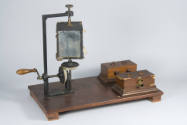
Helmholtz double siren
Datecirca 1870
Inventory Number1997-1-1799a
ClassificationSiren
Subject
Maker
F. Sauerwald
fl. 1860 - 1875
Cultural Region
Place of Origin
Dimensions40.1 x 20.7 x 15.4 cm (15 13/16 x 8 1/8 x 6 1/16 in.)
Material
Accessoriescover and small rubber piece (b)
Bibliography
DescriptionMahogany base with a frame supports the brass double siren. The double siren, of Helmholtz's design, consists of two wind chests linked together on a common, central shaft.
Pressurized air is introduced into the wind chests by means of brass connectors at the top and bottom. The connectors are angled and have a ribbing to better grip the air hoses.
The air escapes through a circle of holes in the wind chest, turning a rotor. A brass crank with an ivory handle at the top of the siren causes the holes in the upper chamber to rotate, thereby chaning the air sent to the rotor. This changes the frequency of the sound. The dial at the crank is divided 0-60 every 1.
The top siren as four, angled, pull stops marked 9, 12, 15, and 16. The lower siren has four more stops marked 8, 10, 12, and 18.
Between the two sirens, there are two silvered counters (or dials). The left one is divided 0-100, counterclockwise by 1. The right counter is divided 0-50, clockwise every 1. Two knurled knobs at the sides of the dial plate allow one to shift it left in order to disengage the dial gears from the sirens' central shaft. The shift is visible in a window on the back.
Each siren has a cover divided into two halves. These are held on by screws. The top pair are replacements made in 1999. Each is stamped, "1999 R. L. Ketchen."
The wooden base is stamped in white ink, "22-26." There is an oval paper sticker marked "19-1-6."
Pressurized air is introduced into the wind chests by means of brass connectors at the top and bottom. The connectors are angled and have a ribbing to better grip the air hoses.
The air escapes through a circle of holes in the wind chest, turning a rotor. A brass crank with an ivory handle at the top of the siren causes the holes in the upper chamber to rotate, thereby chaning the air sent to the rotor. This changes the frequency of the sound. The dial at the crank is divided 0-60 every 1.
The top siren as four, angled, pull stops marked 9, 12, 15, and 16. The lower siren has four more stops marked 8, 10, 12, and 18.
Between the two sirens, there are two silvered counters (or dials). The left one is divided 0-100, counterclockwise by 1. The right counter is divided 0-50, clockwise every 1. Two knurled knobs at the sides of the dial plate allow one to shift it left in order to disengage the dial gears from the sirens' central shaft. The shift is visible in a window on the back.
Each siren has a cover divided into two halves. These are held on by screws. The top pair are replacements made in 1999. Each is stamped, "1999 R. L. Ketchen."
The wooden base is stamped in white ink, "22-26." There is an oval paper sticker marked "19-1-6."
In Collection(s)
Signedbelow dials: F. Sauerwald / in / Berlin
Inscribedabove dials: No. 20
Curatorial RemarksTyler's Museum has a similar double siren by Sauerwald, no. 13, which was purchased in May 1865. See Gerard Turner, <i>The Practice of Science in the Nineteenth Century</i>, 110, item 488.
FunctionThe double siren is a device for determining the absolute frequency of a sound and demonstrating the interference of sound waves through beat phenomena. Two sirens are coupled on the same shaft.
A video recording of a Helmholtz double siren in use is available on Youtube here.
A video recording of a Helmholtz double siren in use is available on Youtube here.
ProvenanceJefferson Physical Laboratory, Harvard University; transferred to CHSI February 12, 1949.

F. Sauerwald
Date: circa 1870
Object number: 1997-1-1799b


Pinkerton Electro Security Corporation
Date: 1953-1966
Accessories: 2 small keys and screw; manual (in CHSI); whole set includes another identical box (RS0917a) and antennas (RS0917b) with accessories
Object number: RS0917

Pinkerton Electro Security Corporation
Date: 1953-1966
Accessories: 2 small keys and screw; manual (in CHSI); whole set includes another identical box (RS0917a) and antennas (RS0917b) with accessories
Object number: RS0917a


Institute of Geographical Exploration
Date: circa 1900
Accessories: winding key; geared allen wrench; leather holster. Associated with printing chronograph.
Object number: DW0471a

German
Date: circa 1922
Accessories: skein of blue and red twine, mounting screw with square base; brown wooden case with hook closure
Object number: DW0627
Kenneth Joseph Launie
Date: 2018
Accessories: geiger counter probe; fake white bird used in B.F. Skinner exhibit
Object number: 0002-3-2018