

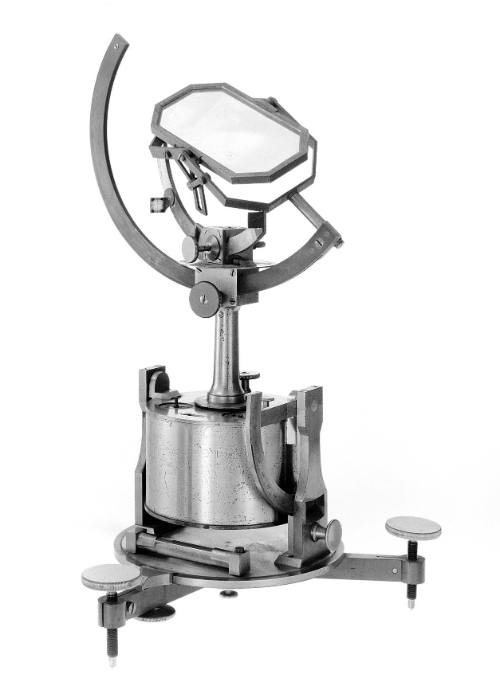


Silbermann-type heliostat
Date1850-1880
Inventory Number2005
ClassificationHeliostat
Subject
Maker
Louis Jules Duboscq
French, 1817 - 1886
Maker
Paul Garnier
1801 - 1869
User
Department of Geology and Geography, Harvard University
1890 - 1961
Cultural Region
Place of Origin
Dimensions37.5 × 27 × 24 cm (14 3/4 × 10 5/8 × 9 7/16 in.)
Material
DescriptionThis is a version of the heliostat originally devised around 1843 by French physicist Johann Theobald Silbermann (1806-1865).
The device consists of a mercury-amalgam glass mirror with an elongated octagonal shape. The mirror is supported by an adjustable brass and steel frame consisting of a semicircular fork whose axis is attached to a clockwork in a metal drum.
The angle of the mirror can be adjusted for solar declination, which is marked in initials of the months every 5 days on one half of the fork. The other half is marked in degrees. There exists a spot aperture and target for fine adjustment on this declination arm. There are three knurled adjustment screws to alter the azimuth and altitude of the mirror. The azimuth is clock driven and marked on a plate below the mirror with French names for the cardinal directions.
The main axis of the instrument goes through a cross-piece, which runs between two legs. Its angle is adjustable for latitude using a quadrant, which is divided into 30' intervals, with a vernier scale on one leg giving 1' divisions. There is a knurled tightening screw.
The two legs are supported on a turntable on a base with three leveling screw feet. The turntable has a bubble level. Its limb is divided 10-0-10 every 1. The clock drum has two silvered dials. Both read 0-60 every 1. A blued needle pointer turns to "A" and "M." Another blued needle marks slow adjustments between
"R" and "A." There is purplish varnish on the side of the drum.
The device consists of a mercury-amalgam glass mirror with an elongated octagonal shape. The mirror is supported by an adjustable brass and steel frame consisting of a semicircular fork whose axis is attached to a clockwork in a metal drum.
The angle of the mirror can be adjusted for solar declination, which is marked in initials of the months every 5 days on one half of the fork. The other half is marked in degrees. There exists a spot aperture and target for fine adjustment on this declination arm. There are three knurled adjustment screws to alter the azimuth and altitude of the mirror. The azimuth is clock driven and marked on a plate below the mirror with French names for the cardinal directions.
The main axis of the instrument goes through a cross-piece, which runs between two legs. Its angle is adjustable for latitude using a quadrant, which is divided into 30' intervals, with a vernier scale on one leg giving 1' divisions. There is a knurled tightening screw.
The two legs are supported on a turntable on a base with three leveling screw feet. The turntable has a bubble level. Its limb is divided 10-0-10 every 1. The clock drum has two silvered dials. Both read 0-60 every 1. A blued needle pointer turns to "A" and "M." Another blued needle marks slow adjustments between
"R" and "A." There is purplish varnish on the side of the drum.
Signedon instrument: Fait par J. Duboscq à Paris / No. 116.
Inscribedon instrument: J. T. Silbermann Invteur
Curatorial RemarksThe winding key is engraved: "WATERBURY CLOCK Co. USA.", which suggests the original has been lost.
FunctionThe heliostat is designed to reflect a beam of sunlight in a fixed direction, and uses a clockwork driven mirror to counteract the apparent motion of the sun through the sky. The resulting steady beam of sunlight would often be projected into a laboratory for experiments requiring intense light, physical optics studies, microscopy, analysis of the solar spectrum, etc.
For more information on how this type of heliostat worked, see the following website (in French).
For a representation of this instrument in one of Duboscq's trade catalogue, see the following website.
For more information on how this type of heliostat worked, see the following website (in French).
For a representation of this instrument in one of Duboscq's trade catalogue, see the following website.
ProvenanceFrom the Departement of Geology and Geography (mineralogy), Harvard University.


Louis Jules Duboscq
Date: 1850-1880
Accessories: RAPPORT FAIT A L'ACADEMIE ROYAL SCIENCES SUR UN NOUVEL HELIOSTAT, Presente par M. SILBERMAN aine. (in instrument file folder)
Object number: 2000

W. Watson & Sons Ltd.
Date: circa 1885
Accessories: oculars (2 pairs): B and D; objectives in marked canisters (4): 1/4, 1/2, 1, 3 inches; condenser with iris diaphragm; rotating wheel diaphragm; iris diaphragm; set of 4 disk diaphragms in brass box; triple nosepiece; live box; prisms for Wenham binocular system (2); stage for simple microscope with rotating wheel diaphragm; vulcanite stage; spare knobs (2); parts box; case
Object number: 1249

Alvan Clark and Sons
Date: 1910
Object number: 2003-1-0077b
James Short
Date: circa 1763
Accessories: split object glass micrometer; spare secondary mirror in tin box (0002b).
Object number: 0002

Buff & Buff Manufacturing Company
Date: circa 1905
Accessories: wood case; leather case; right-angle prism; plumb bob; oil flask; tripod (5174b)
Object number: 5174a


W. & L. E. Gurley
Date: ca. 1884
Accessories: solar attachment; case; level; green filter; sun shade; tripod (5163b)
Object number: 5163a

W. W. Boes Company
Date: circa 1940
Accessories: Bakelite case with instruction manual and advertisement
Object number: DW0915

W. W. Boes Company
Date: circa 1944
Accessories: Instruction booklet (lib. 5155), case with strap, advertising flyer
Object number: 1996-1-0479

Sperti, Inc.
Date: circa 1944
Accessories: case with strap
Object number: 1996-1-0480
See also/See also
