


electric motor timer
Datecirca 1880
Inventory NumberDW0095
ClassificationTimer
Subject
Maker
French
?
Cultural Region
Dimensions15.3 × 16.8 × 11.3 cm (6 × 6 5/8 × 4 7/16 in.)
Material
Accessoriesprotecting case with glass window
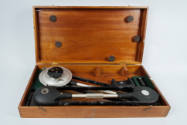
DescriptionThis object sits on a (horizontally oriented) rectangular wooden platform, which in turn sits on its four rectangular wooden feet, one at each corner. A small brass ring is screwed into the wood near each of the short edges of the base. The instrument can be stored in a wooden case that sits on top of the instrument's wooden platform, using it as its bottom panel. The case has a brass hook on each smaller side that hooks into the rings on the base plate, holding the case together. The case has one glass side panel through which the instrument is visible.
There is a rectangular, black metal base-plate screwed to the center of the wooden platform. A tall, hollow brass rectangle stands upright near the middle of the black rectangular base. Inside this hollow rectangle is a brass wheel with four thin spokes; the rim of the wheel is serrated with sharp gear teeth. The cylindrical, brass axle of the wheel extends through the vertical brass rectangle on both sides.
On one side, a cylindrical brass pole runs through the protruding axle. This pole has a brass puck at each end, and extends just beyond the circumference of the brass wheel. Another, telescoping, cylindrical brass pole extends from the axle on this side, perpendicular to the other, puck-ended pole. The tip of a downward pointing brass triangle lines up with the center of the axle on this side. A small, thin brass pole with a small brass puck at the end emerges through a hole at the top of this triangle. The mechanism on this weight constitutes a balance mechanism for controlling the motion of the wheel. The protruding axle on the other side of the devices ends with a brass disc, shaped like a button (the type one might find on an article of clothing).
There is another brass puck fixed to the top of the brass rectangle post on this side of the instrument. It is attached via a short, cylindrical brass pole to another brass puck (looking like a suspended lollipop off to one side) and also to a partial brass wheel (about 1/8 arc section) with a serrated edge. The serrated edge is geared to the axle in between the brass rectangle post and the button-shaped disc. Also emerging from this interval is a rectangular, black metal bar, lying flat. Its other end is attached to a thin, shorter rectangular post standing right at one short edge of the black base plate. There is an iron sheet bolted to this post that curls up and over the black metal bar and is screwed to its top face. A thin brass pole (looks like a proboscis) also emerges from the same interval between the post and the button shaped disc and curls at the other end. This curled end is attached to the iron sheet. The connection is soldered, so it may or may not be original.
In between the button-shaped brass disc and this brass post there are two, tightly wound coils of wire in black insulation on a wooden spool. The axles are vertical relative to the floor. On both sides of the instrument, the coils are connected to contacts built into the black base with excess, black spiraling wire. There are three brass connectors attached to the wooden platform along the long edge on this side of the instrument.
A short brass bar emerges from the bottom of the button shaped brass disc. Next to it, a short brass spring is attached vertically to the device. Below the bar, there is a black rectangular box with one raised end, attached to the metal base-plate. There are two brass strips screwed to the top of this box. Each brass strip has an extra brass screw at the extremity. There is a copper wire wrapped around each that attaches to the wooden base platform.
There is a rectangular, black metal base-plate screwed to the center of the wooden platform. A tall, hollow brass rectangle stands upright near the middle of the black rectangular base. Inside this hollow rectangle is a brass wheel with four thin spokes; the rim of the wheel is serrated with sharp gear teeth. The cylindrical, brass axle of the wheel extends through the vertical brass rectangle on both sides.
On one side, a cylindrical brass pole runs through the protruding axle. This pole has a brass puck at each end, and extends just beyond the circumference of the brass wheel. Another, telescoping, cylindrical brass pole extends from the axle on this side, perpendicular to the other, puck-ended pole. The tip of a downward pointing brass triangle lines up with the center of the axle on this side. A small, thin brass pole with a small brass puck at the end emerges through a hole at the top of this triangle. The mechanism on this weight constitutes a balance mechanism for controlling the motion of the wheel. The protruding axle on the other side of the devices ends with a brass disc, shaped like a button (the type one might find on an article of clothing).
There is another brass puck fixed to the top of the brass rectangle post on this side of the instrument. It is attached via a short, cylindrical brass pole to another brass puck (looking like a suspended lollipop off to one side) and also to a partial brass wheel (about 1/8 arc section) with a serrated edge. The serrated edge is geared to the axle in between the brass rectangle post and the button-shaped disc. Also emerging from this interval is a rectangular, black metal bar, lying flat. Its other end is attached to a thin, shorter rectangular post standing right at one short edge of the black base plate. There is an iron sheet bolted to this post that curls up and over the black metal bar and is screwed to its top face. A thin brass pole (looks like a proboscis) also emerges from the same interval between the post and the button shaped disc and curls at the other end. This curled end is attached to the iron sheet. The connection is soldered, so it may or may not be original.
In between the button-shaped brass disc and this brass post there are two, tightly wound coils of wire in black insulation on a wooden spool. The axles are vertical relative to the floor. On both sides of the instrument, the coils are connected to contacts built into the black base with excess, black spiraling wire. There are three brass connectors attached to the wooden platform along the long edge on this side of the instrument.
A short brass bar emerges from the bottom of the button shaped brass disc. Next to it, a short brass spring is attached vertically to the device. Below the bar, there is a black rectangular box with one raised end, attached to the metal base-plate. There are two brass strips screwed to the top of this box. Each brass strip has an extra brass screw at the extremity. There is a copper wire wrapped around each that attaches to the wooden base platform.
In Collection(s)
Signedunsigned
FunctionAn electric motor operated timer. The rotation of the brass wheel is controlled by the balance lever mechanism on one side, permitting about a minute cycle.
ProvenanceDavid Wheatland purchased from Roux-Devillas Paris, May 14, 1966 (lot 5/66).

Charles Bruning Company
Date: 1942
Accessories: plywood case; 3/4 inch wrench; black metal end pieces
Object number: 2003-1-0127


Hammond Typewriter Company
Date: circa 1923
Accessories: four Hammond type shuttles for different type faces, each with a wooden storage box; four laminated paper rectangles with symbol placement guide; instruction book, instruction sheets, advertisements, and correspondence (in object file)
Object number: 1996-1-0373

Benjamin Martin
Date: circa 1766
Accessories: rope cord belt
glass globe
conducting pad
in folder: photographs, page containing description, history, and discussion of design, note from Ebenezer Gay regarding conservation work, excerpt from David Pingree Wheatland and I. Bernard Cohen, A Catalogue of Some Early Scientific Instruments at Harvard University (Cambridge, MA: Harvard University, 1949), woodcut with picture of instrument from B. Martin, Young Gentleman and Lady's Philosophy (1759): 139.
X-ray images of parts of the machine can be found in C1-A7.
Object number: 0013


Gebrüder Haff
Date: circa 1940
Accessories: case
Object number: 1997-1-0446

Gebrüder Haff
Date: circa 1940
Accessories: card with instrument info and conversion table; photocopy of letter from Dr. Joachim Fischer to William J.H. Andrewes, dated 12 May 1997; photocopy of extract from Dr. Joachim Fischer's inventory of integrating instruments included with the letter
Object number: 1997-1-0444