


gold-leaf electroscope
Date1870-1890
Inventory NumberDW0044
ClassificationElectroscope
Subject
Maker
E. Ducretet & Cie
1864 - 1931
Cultural Region
Place of Origin
Dimensions27 x 10 cm (10 5/8 x 3 15/16 in.)
Material
DescriptionA glass jar with a narrow neck stoppered by a rubber cap that has a rod going through it. The rod has a brass ball on top, while at the bottom, inside the jar, hang two thin gold leaves. Inside the jar there are in addition two metallic balls supported by narrow metallic rods coming from the bottom.
Signedon instrument: E. DUCRETET & CIE A PARIS
FunctionThis is an instrument that measures the amount of electric charge on an object's surface. One would touch the object to be measured with the metallic ball on top. This would charge the ball, rod and gold strips with an amount of charge proportional to that of the object.
As equal charges repel each other, the two gold strips separate forming a "V" shape. The angle of this "V" gives an indication of how charged is the object that was touched. If the electroscope is small in comparison to the measured object, the amount of electric charge that it takes away from it is small. In addition, if the object has a considerable electric charge, even without physical contact with the metallic ball the gold strips will separate, as proximity to the ball will push positive charge away from it, towards the gold strips.
The two balls held from the bottom are grounded and are at the maximum angle that the gold strips should extend. If the electric charge is so much that it makes the angle wider, the gold strips touch the balls and are immediately discharged.
As equal charges repel each other, the two gold strips separate forming a "V" shape. The angle of this "V" gives an indication of how charged is the object that was touched. If the electroscope is small in comparison to the measured object, the amount of electric charge that it takes away from it is small. In addition, if the object has a considerable electric charge, even without physical contact with the metallic ball the gold strips will separate, as proximity to the ball will push positive charge away from it, towards the gold strips.
The two balls held from the bottom are grounded and are at the maximum angle that the gold strips should extend. If the electric charge is so much that it makes the angle wider, the gold strips touch the balls and are immediately discharged.
ProvenanceDavid Wheatland purchased from Roux-Devillas Paris, May 14, 1966 (lot 5/46).

E. Ducretet & Cie
Date: 1870-1890
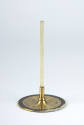
Accessories: the upper part of the capacitor is DW0045b.
Object number: DW0045a




Central Scientific Company
Date: circa 1940
Accessories: 2 Leyden condensers made of Pyrex
One rubber **gutta percha?** pulley, rotted.
Object number: 1997-1-0634

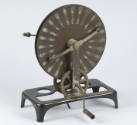
E. Ducretet & Cie
Date: circa 1879
Accessories: None
Object number: 1999-1-0018




See also/See also
