


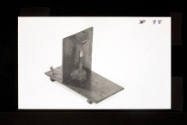

carbon pencil microphone
Datecirca 1879
Inventory NumberDW0098
ClassificationMicrophone
Subject
Inventor
David Edward Hughes
1831 - 1900
Cultural Region
Place of Origin
Dimensions10.7 × 8 × 15.2 cm (4 3/16 × 3 1/8 × 6 in.)
Material
DescriptionAn early microphone, known as a carbon pencil microphone, after the pencil-shaped carbon pendulum that formed part of the device. The device is also known as a Hughes Microphone, after its inventor Professor David Edward Hughes, a British-born American inventor. Hughes also invented the printing telegraph.
The microphone is mounted on a flat base board, supported on rubber feet. The base board has a pair of brass binding posts with knurled-edge knobs on one end, connected by copper wire to the microphone assembly. The assembly is mounted on an upright attached to the center of the base board.
The assembly consists of a block of carbon attached by a brass bracket to the top edge of the upright, from which a pencil-shaped piece of carbon is suspended from a wire so that its tip is in loose contact with a second block of carbon mounted at the base of the upright.
The microphone is mounted on a flat base board, supported on rubber feet. The base board has a pair of brass binding posts with knurled-edge knobs on one end, connected by copper wire to the microphone assembly. The assembly is mounted on an upright attached to the center of the base board.
The assembly consists of a block of carbon attached by a brass bracket to the top edge of the upright, from which a pencil-shaped piece of carbon is suspended from a wire so that its tip is in loose contact with a second block of carbon mounted at the base of the upright.
Signedunsigned
FunctionAn early form of microphone to pick up sound and convert it to an electrical signal. It consists of a pencil-shaped carbon rod gently touching a carbon block, closing an electrical circuit.
Since the contact between the pieces is so loose, sound vibrations are detected.
A very good video including an explanation recorded with one such devices, was made by Ron Langhans and Rick Havyatt for the Historical Radio Society of Australia. It is available online here.
Since the contact between the pieces is so loose, sound vibrations are detected.
A very good video including an explanation recorded with one such devices, was made by Ron Langhans and Rick Havyatt for the Historical Radio Society of Australia. It is available online here.
ProvenanceDavid Wheatland purchased from Roux-Devillas Paris, May 14, 1966 (lot 5/9).


Western Electric Company
Date: 1920-1930
Object number: RS1359

Western Electric Company
Date: 1936
Object number: RS0484

Western Electric Company
Date: 1936
Accessories: A green felt storage bag.
Object number: RS1113

Louis-Clément Breguet
Date: 1870-1885
Object number: 1997-1-0899

Francis West
Date: circa 1829
Accessories: Plastic envelope containing tag and handle parts; box
Object number: DW0435

General Radio Company
Date: circa 1970
Accessories: calibration chart, included in box.
Object number: 2003-1-0118


General Radio Company
Date: circa 1984
Accessories: Microphone storage case of wood and plastic
Object number: 1999-1-0082