


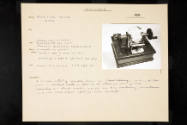

rotating slide wire
Date1893-1912
Inventory Number0416
ClassificationResistance
Subject
Maker
Hartmann & Braun AG
1879 - 1999
Supplier
Queen & Company
1893 - 1912
User
Department of Physics, Harvard University
founded 1884
Cultural Region
Place of Origin
Place of Use
Dimensions18.4 × 24.2 × 17.6 cm (7 1/4 × 9 1/2 × 6 15/16 in.)
Material
DescriptionA 4-inch rotating marble drum on fixed bearings, 10 turns of fine wire in contact with a sheave on wheel on a sliding rod. Mounted on hard rubber panel on box containing resistances of 1, 10, 100, and 1000 ohms, plugs and contacts.
Signedstamped on panel: HARTMANN & BRAUN FRANKFURT A/M NO 69
marked on oval plate: SOLE AGENTS FOR U.S.A. / JAMES W. QUEEN & CO. / PHILADELPHIA
Inscribedstamped on panel: RICHTIG BEI 19 GRAD CELSIUS
Curatorial RemarksPart of Kirchoff Bridge.
FunctionSlide wires are a form of very precise variable resistances. Like most resistance boxes, it contains several resistances of increasing magnitudes that can be activated or bypassed, in order to add their values. In addition to these, they include a coil of wire through which the current will pass. The resistance will vary depending on the location of a point of contact with the wire. This allows for a continuous, rather than stepwise increase in the resistance. In this particular case, the resistance is changed by turning the spool handle.
Like other continuous devices for variable resistance, they were mostly used for the precise measurement and regulation of electric currents.
Like other continuous devices for variable resistance, they were mostly used for the precise measurement and regulation of electric currents.
ProvenancePhysics Department, Harvard University. (Lyman 238 April 6 1963).


Hartmann & Braun AG
Date: 1900-1920
Accessories: plugs (8)
Object number: 1997-1-0399


Hartmann & Braun AG
Date: circa 1920
Accessories: 6 plugs
Object number: 1997-1-0400


