


simple calorimeter
Date1850-1900
Inventory Number1997-1-1142
ClassificationCalorimeter
Subject
Maker
American
?
Cultural Region
Dimensions27 × 16.3 × 14.3 cm (10 5/8 × 6 7/16 × 5 5/8 in.)
Material
Accessoriescalorimeter; stand; lid
DescriptionThis object has three parts: the stand, the cup and the lid.
The stand is made up of a hollow metal circle. At three equally spaced points around the circle, there are small half-circle protrusions, under which are connected three long thin metal rods that function as tall legs. The legs have no feet.
The cup's shape brings to mind an empty half of a capsule; the bottom is rounded.
It has a small lip around its rim. The cup is fitted so as to plug into the stand's hollow metal circle at approximately two-thirds of the way up its body; in this configuration, the cup's bottom remains high off of the ground. The cup, which is made of thick metal, seems to have two walls. The hollow space between these walls is only accessible through a small hollow cylinder perched atop the cup, on one side.
The lid of the cup is a thin metal disc. It has an arch-shaped hole to accomodate for the small hollow cylinder on one side of the cup. On the opposite side of the lid, however closer to the center than to the edge, is a much smaller round hole. In the middle of the lid is an additional small hollow cylinder. As well there is a rotatable 'S' shaped flap, attached to the top of the lid on the left side, near its center. There is a pale round sticker on the lid, hand-labeled simply 'G'. Around the lid are several small speckled greenish rust stains.
The stand is made up of a hollow metal circle. At three equally spaced points around the circle, there are small half-circle protrusions, under which are connected three long thin metal rods that function as tall legs. The legs have no feet.
The cup's shape brings to mind an empty half of a capsule; the bottom is rounded.
It has a small lip around its rim. The cup is fitted so as to plug into the stand's hollow metal circle at approximately two-thirds of the way up its body; in this configuration, the cup's bottom remains high off of the ground. The cup, which is made of thick metal, seems to have two walls. The hollow space between these walls is only accessible through a small hollow cylinder perched atop the cup, on one side.
The lid of the cup is a thin metal disc. It has an arch-shaped hole to accomodate for the small hollow cylinder on one side of the cup. On the opposite side of the lid, however closer to the center than to the edge, is a much smaller round hole. In the middle of the lid is an additional small hollow cylinder. As well there is a rotatable 'S' shaped flap, attached to the top of the lid on the left side, near its center. There is a pale round sticker on the lid, hand-labeled simply 'G'. Around the lid are several small speckled greenish rust stains.
Signedunsigned
Inscribedon sticker on lid: G
FunctionThis calorimeter was made to determine the heat capacity of a substance and/or to determine the heat released or absorbed in a chemical reaction.
The cup would be filled with water at a known temperature. A thermometer would be dropped through the hole in the center of the lid. The substance to be measured and/or the product of the chemical reaction would be added to the water and the difference in temperature would be recorded. Given the duration of the reaction, the mass of the water, and the heat capacity of water, this rise or fall in temperature could give an appropriate calculation for the heat captured/released from the reaction and/or the specific heat capacity of the substance.
The cup would be filled with water at a known temperature. A thermometer would be dropped through the hole in the center of the lid. The substance to be measured and/or the product of the chemical reaction would be added to the water and the difference in temperature would be recorded. Given the duration of the reaction, the mass of the water, and the heat capacity of water, this rise or fall in temperature could give an appropriate calculation for the heat captured/released from the reaction and/or the specific heat capacity of the substance.
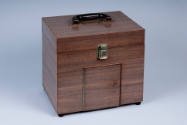
Beckman Instruments, Inc.
Date: circa 1955
Accessories: instructions attached to underside of box lid
Object number: 1996-1-0276

E. Hartnack & A. Prazmowski
Date: circa 1880
Accessories: objectives in green leather box (5): 2, 4, 6, 7, and unmarked; objectives in brown box (2): 2, 3; oculars (5); 1, 2, 3, 4, 5; polarizing eyepiece and substage apparatus; substage condenser; substage cup diaphragms (4); slider with sleeve to hold substage accessories; large bull's eye condenser with stand; aperture-stop rotating wheel; blue filters (3); flat case; case keys (2).
Object number: 1145a

English
Date: circa 1820
Accessories: 5 brass weights, brass holder, piece of lead
Object number: DW0227

Date: circa 1880
Accessories: mahogany case; hot cup manipulator; thermometers (2)
Object number: 3862


English
Date: circa 1800
Accessories: Two insulated charge transfer wands.
Object number: 0014


Thomas Hall
Date: circa 1890
Accessories: pulley rope
Object number: 1997-1-1423

American
Date: late 19th-early 20th Century
Accessories: tilting arm (0380b)
Object number: 0380a

American
Date: late 19th-early 20th Century
Accessories: goes with reversing switch (0380a)
Object number: 0380b
