

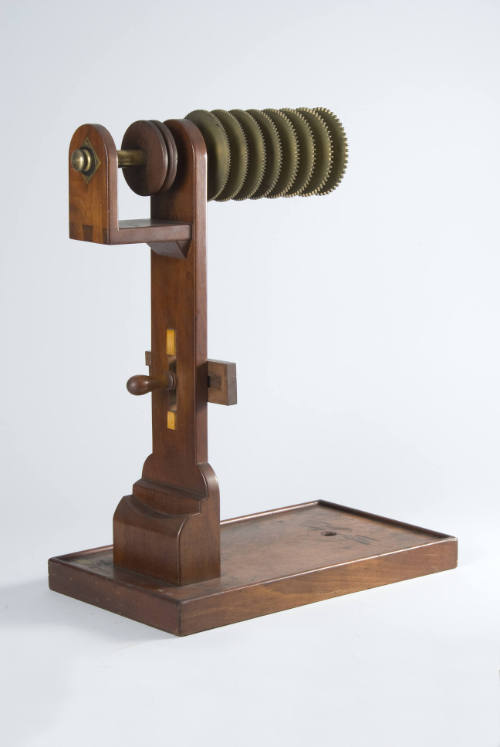
Savart's wheels
Date1870-1910
Inventory Number1997-1-0950
ClassificationSavart's Wheel
Subject
Maker
French
Inventor
Félix Savart
1791 - 1841
Cultural Region
Dimensions55 x 44 x 25 cm (21 5/8 x 17 5/16 x 9 13/16 in.)
Material
DescriptionThe base of this instrument is rectangular. At one end is a hole with threads in it. It was used to screw in the (missing) column supporting one or more sounding cards under the brass wheels. At the other end of the base is the supporting column for the eight equally-spaced toothed wheels (in front) and a grooved one (in the back). The toothed wheels all have isocele teeth in multiple of six (8-9-10-11-12-13-14-15): 48 for the first one in the front; 54 for the second one; 60 for the third; 66 for the fourth; 72 for the fifth; 78 for the sixth; 84 for the seventh; and 90 for the eighth and final one. The grooved wheel was used with a mechanical or later electrical machine to put the toothed wheels in a regular rotational motion.
As several other acoustical instruments in the collection, this one has an old location number inscribed on an oval paper glued to the side: 19-1-2. There is another old location number stamped on this instrument: 20-19.
As several other acoustical instruments in the collection, this one has an old location number inscribed on an oval paper glued to the side: 19-1-2. There is another old location number stamped on this instrument: 20-19.
In Collection(s)
Signedon third front wheel, stamped: illegible
Curatorial RemarksThis instrument is most likely French. There is only one stamp mark, on the third wheel from the front. It is, however, very faint and is as yet unidentified.
FunctionThis instrument was used to produce specific sounds by letting a rigid card come into contact with the rotating wheels. If the wheels rotate at a constant speed, putting two cards on separate wheels can generate different kinds of pitches. For instance, owing to the number of teeth on these wheels, the diatonic scale can be entirely reproduced. For instance, the 9/8 tone with the 1st and 2nd wheels; the 4/3 tone with the 2nd and 5th wheels; the 15/8 tone with the 1st and 8th wheels, etc.
The French physicist Félix Savart (1791-1841) devised this system of generating sound frequencies and used these toothed wheels to try to determine the upper limit of audible frequencies.
The French physicist Félix Savart (1791-1841) devised this system of generating sound frequencies and used these toothed wheels to try to determine the upper limit of audible frequencies.


E. Leybold Nachfolger
Date: 1900-1910
Object number: 1996-1-0314


Daniel Davis, Jr.
Date: circa 1848
Object number: 1997-1-1801


Rudolph Koenig
Date: circa 1865
Object number: 1997-1-0918


Rudolph Koenig
Date: circa 1865
Object number: 1997-1-0901


Charles Babbage
Date: 1822-1834, reassembled in 1886
Object number: 1991-1-0001a

Blue Hill Meteorological Observatory
Date: 1890-1910
Accessories: wind vane and anemometer (1996-1-0145b); additional anemometer cup (1996-1-0145c)
Object number: 1996-1-0145a