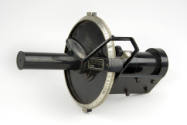
Lummer-Brodhun photometer
Date1900-1920
Inventory Number1997-1-0879
ClassificationPhotometer
Subject
Maker
German
Cultural Region
Dimensions27 × 35.2 × 9.2 cm (10 5/8 × 13 7/8 × 3 5/8 in.)
Material
DescriptionThe photometer consists of an opaque screen which can be removed from a box. On either side of the screen are two swing-away doors, each with a square aperture in the center. In the box above the screen are two mirrors and a pair of prisms, which direct the light from the two light sources (outside the box) into the eyepiece at the top of the box. One side of the mirror housing in penciled "L" and the other "R."
The housing is missing one side. The other side is plain.
The housing is attached to a yoke on which it pivots. The yoke is attached to a brass rod for insertion into an optical bench or other equipment.
The housing is missing one side. The other side is plain.
The housing is attached to a yoke on which it pivots. The yoke is attached to a brass rod for insertion into an optical bench or other equipment.
Signedunsigned
Inscribedpainted on top of housing: 90
FunctionThis instrument was used in comparing the brightness of an unknown source of light with that of a standard one. Light rays from the two sources enter on either side of the box. They first strike a white slab. Some of the scattered light on each side is reflected by mirrors towards what is called a Lummer-Brodhun cube, which consists of two right-angled prisms. What the observer sees in the eyepiece is two superimposed circles on top of each other, one smaller than the other. When the brightness are identical, the two circles become one. By moving the unknown light source farther or closer to the photometer, one tries to get rid of the two distinct circles. When this is accomplished, the luminosity of the unknown source can be calculated.
For a fuller description, see the following website.
For a fuller description, see the following website.


Carl Zeiss Jena
Date: circa 1926
Accessories: wooden box with two hook-and-eye latches to fasten front opening; in instrument file: instruction book (photocopy); Geissler tube labeled "H2"; carboard tube containing German thermometer C in stainless steel holder that screws into instrument; glass bottle with cork stopper labeled "Monobromnaphthalin, Germany nD=1 658"; small round cardboard box labeled "For Pulfrich Refractometer" containing one tubulure
Object number: 1996-1-0229

Zeiss-Aerotopograph
Date: circa 1950
Accessories: instrument is in original wood storage/carrying case. listed accessories: base plate, mirrors (2) and tubular holders (2), anchors (2), prism yoke, monocular adapter, lighting set with bulbs (3, one currently in lamp, its box in box of 2009-1-0002b), 2 monoculars (4 or 6 power) [6x24 (infinite) L or R Zeiss aerotopo logo), "fork"-shaped support (V rather), green filters (2) , dioptre lenses (2), strabismus-correcting lenses (2), photo holder, permanent magnets (8)
Object number: 2009-1-0002a


Arthur Howland
Date: circa 1920
Accessories: color discs
Object number: 1997-1-0986


Adam Hilger Ltd.
Date: circa 1920
Accessories: case, adaptive collars, aperture stops (2): 1/4, 1/6
Object number: 1997-1-1835