

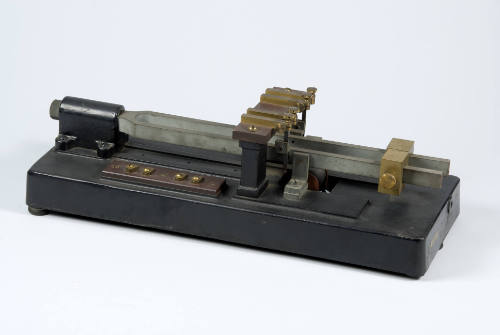


electromagnetic tuning fork
Date1915-1920
Inventory Number1997-1-0878
ClassificationTuning Fork
Subject
Manufacturer
Western Electric Company
1869 - 1995
Cultural Region
Place of Origin
Dimensions17 x 20 x 51 cm (6 11/16 x 7 7/8 x 20 1/16 in.)
Material
DescriptionA steel tuning fork is fixed at one end of a rectangular base. On the base, four connectors are added to power the apparatus in electricity. Two pairs of brass connectors are supported by a steel and bakelite bridge in the middle of the apparatus. When the electromagnetic coil is powered, it forces the tuning fork to vibrate (the frequency of the vibration is fine-tuned by two sliding weights attached to each fork). A fine metallic strip is added to each fork, and when the latter vibrates the strips come on and off contact with each pair of elevated connectors supported by that bridge. It is what produces or regulates the transmission of a multiplicity of sound signals. A switch turns the whole apparatus on and off.
Signedon front: Western Electric / COMPANY / PATENT APPLIED FOR IN U.S.A
Inscribedon each column: ES 139805 DET 5
FunctionThis device was used in operating a phonic-wheel motor, which was itself used in the transmission of electrical signal carrying the voice in early telephony. This being a multiplex tuning fork, it could dispatch several different signals at the same time.


Louis Jules Duboscq
Date: circa 1870
Object number: 1997-1-0929

Louis Jules Duboscq
Date: circa 1870
Object number: 1997-1-0930

Rudolph Koenig
Date: circa 1889
Object number: 1997-1-0884

Rudolph Koenig
Date: circa 1865
Object number: 1996-1-0421

Rudolph Koenig
Date: circa 1865
Object number: 1997-1-0892f

Rudolph Koenig
Date: circa 1865
Object number: 1997-1-0892d

Rudolph Koenig
Date: circa 1865
Object number: 1997-1-0892c
Rudolph Koenig
Date: circa 1865
Object number: 1997-1-0892g

Rudolph Koenig
Date: circa 1865
Object number: 1997-1-0892h