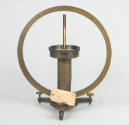
tangent galvanometer
Date1880-1910
Inventory Number0326a-m
ClassificationTangent Galvanometer
Subject
Maker
American
?
User
Department of Physics, Harvard University
founded 1884
Cultural Region
Place of Use
Dimensions19 x 16.5 x 16.5 cm (7 1/2 x 6 1/2 x 6 1/2 in.)
Material
DescriptionGalvanometer consists of a coil of fine wire that slides on a brass cylinder etched on both sides with a scale marked from 0-6 and fitted with removable end piece (0326m). Two removable microscope objectives (0326e-d) mounted on both sides of coil for reading scale. A mirror and magnet on short suspension are contained within the horizontal cylinder. Cylinder is rusted on the exposed portions not covered by the coil. Coil and cylinder are mounted on black tripod base with
three leveling screws and attached to wooden base (0326c). The galvanometer fits into a square mahogany case (0326b) with a brass carrying handle. Box contains the following accessories: three mounting plates for leveling screws (0326f-g-h), a U-shaped loop for withdrawing parts (0326k), a small Phillips head screwdriver (0326j), a brush (0326i), and a key for locking the box (0326l). The box also contains three unmarked small white screws made of an ivory-like substance.
three leveling screws and attached to wooden base (0326c). The galvanometer fits into a square mahogany case (0326b) with a brass carrying handle. Box contains the following accessories: three mounting plates for leveling screws (0326f-g-h), a U-shaped loop for withdrawing parts (0326k), a small Phillips head screwdriver (0326j), a brush (0326i), and a key for locking the box (0326l). The box also contains three unmarked small white screws made of an ivory-like substance.
Signedunsigned
FunctionA tangent galvanometer measures the strength of an electric current. It has a circular coil with a turn of wire and a magnetic needle at the center that is either balanced on a point or suspended by a fiber of silk or quartz. The meter has to be first aligned in the north-south direction and thus the instrument takes into account the earth's magnetic field. When a current is sent through the coil, the needle is deflected according to the vector sum of the field produced by the earth and by the unknown current in the coil. The tangent of the needle's angle of deflection is proportional to the strength of the unknown current producing it.
For more information, go to the following website.
For more information, go to the following website.
ProvenanceFrom the Department of Physics, Harvard University, 1/31/1957.


Department of Physics, Harvard University
Date: circa 1893
Accessories: extra scale (0190b)
Object number: 0190a