


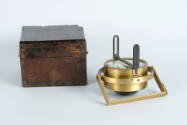
mariner's compass
Datecirca 1850
Inventory NumberDW0346
ClassificationMagnetic Compass
Subject
Maker
Paul-Gustave Froment
1815 - 1865
Cultural Region
Place of Origin
Dimensions7.7 × 19.8 × 19.8 cm (3 1/16 × 7 13/16 × 7 13/16 in.)
box: 5.1 × 16.2 × 16.2 cm (2 × 6 3/8 × 6 3/8 in.)
blue board box: 10.8 × 23.8 × 24.4 cm (4 1/4 × 9 3/8 × 9 5/8 in.)
box: 5.1 × 16.2 × 16.2 cm (2 × 6 3/8 × 6 3/8 in.)
blue board box: 10.8 × 23.8 × 24.4 cm (4 1/4 × 9 3/8 × 9 5/8 in.)
Material
DescriptionDry card (5 1/4") compass with one heavy gimbal and glass covers on top and bottom. Card is marked with 32 points and 0-90 degrees in quadrants.
Brass cylindrical compass mounting box with glass top and bottom c. 1850 marked MARINE IMPERIAL on compass rose. Fixed compass card with 8 pointed star & degree scale in quadrants from 0 degrees to 90 degrees. Gimbal ring attached.
Brass cylindrical compass mounting box with glass top and bottom c. 1850 marked MARINE IMPERIAL on compass rose. Fixed compass card with 8 pointed star & degree scale in quadrants from 0 degrees to 90 degrees. Gimbal ring attached.
Signedon frame in script: Froment a Paris; on compass card and on frame (below anchor): MARINE IMPERIALE
Inscribedframe marked: No, 336
FunctionThe mariner's compass was used to help seamen navigate their way across the seas. The Pole Star served as the seaman's lodestar, or star that leads the way. So the magnetic stone which was used to magnetize the compass was a lodestone.
This particular compass can be mounted from ceiling and viewed from underneath.
From the How Stuff Works Website, available here:
"The Mariner's Compass consists of a round card, called a compass card, with several parallel steel magnets attached to the underside, and a steel pivot at the center. The compass is mounted on a series of rings in such a way that the dial (compass card) remains horizontal, no matter how the ship may pitch and toss. The rings, called gimbals, and compass are placed in a box called a binnacle. On the binnacle, a vertical line called the lubber line marks the direction in which the ship's bow is pointed. The person who steers the ship keeps on course by aligning the lubber line with the compass card point that marks the heading the ship is to follow."
This particular compass can be mounted from ceiling and viewed from underneath.
From the How Stuff Works Website, available here:
"The Mariner's Compass consists of a round card, called a compass card, with several parallel steel magnets attached to the underside, and a steel pivot at the center. The compass is mounted on a series of rings in such a way that the dial (compass card) remains horizontal, no matter how the ship may pitch and toss. The rings, called gimbals, and compass are placed in a box called a binnacle. On the binnacle, a vertical line called the lubber line marks the direction in which the ship's bow is pointed. The person who steers the ship keeps on course by aligning the lubber line with the compass card point that marks the heading the ship is to follow."
ProvenanceDavid Wheatland purchased from Alain Brieux, Paris, March 8, 1968 (lot 30/14).

J. Molteni & Cie
Date: circa 1860
Accessories: rests on a wooden stand
Object number: DW0310


Samuel Thaxter & Son
Date: 1825-1843
Object number: DW0519
Richard Patten
Date: 1813-1840
Accessories: wooden box
Object number: DW0138

E. S. Ritchie & Sons
Date: 1919
Accessories: case
Object number: 5330b


E. S. Ritchie & Sons
Date: 1919
Accessories: azimuth circle (5330b)
Object number: 5330a