


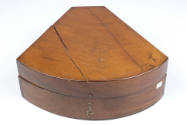


sextant
Date1770-1785
Inventory Number5252
ClassificationSextant
Subject
Attributed to
George Adams (I)
1709 - 1772
Attributed to
George Adams (II)
English, 1750 - 1795
Cultural Region
Place of Origin
Dimensions26.7 x 27.5 x 9.7 cm (10 1/2 x 10 13/16 x 3 13/16 in.)
box: 10.2 x 33 x 29.6 cm (4 x 13 x 11 5/8 in.)
box: 10.2 x 33 x 29.6 cm (4 x 13 x 11 5/8 in.)
Material
Accessoriescase; telescope; spare shade
Bibliography
DescriptionThe frame of this elegant sextant was designed with two kinds of metallic alloys: one for the triangular sides, and another for the oval and circles composing the structural soundness of the instrument. This sextant is equipped with a telescope, three horizon shades, four index shades, a graduated scale of -2° to 138° on the limb and a vernier for precision measurements. The latter has a magnifying lens and a tangent screw for minute readings. The handle is a long black-painted wooden cylinder. As most octants and sextants, this one has three short feet so it can be put down on a table when not in use.
The instrument has its original keystone mahogany box with lock. There are long and short telescopes, and an eyepiece shade.
The instrument has its original keystone mahogany box with lock. There are long and short telescopes, and an eyepiece shade.
In Collection(s)
Signedon limb: Adams London
Curatorial RemarksThis is a case where it is difficult to ascertain which Adams made this instrument.
XRF analysis of the metals was done by Katherine Eremin and Sara Schechner in August 2007.
FunctionThe sextant is an angle-measuring instrument used in navigation and astronomy to determine the altitude of celestial objects, such as the sun and starts. It can measure wider angles than the octant (up to 120°), and was commonly used to determine the angular separation between stars and the moon in order to find the longitude at sea by the lunar-distance method.
A video demonstration of a sextant was produced by the Harvard Museums of Science and Culture in association with the 2015 exhibit “Finding Our Way: Exploring Human Navigation” and is available on YouTube here.
A video demonstration of a sextant was produced by the Harvard Museums of Science and Culture in association with the 2015 exhibit “Finding Our Way: Exploring Human Navigation” and is available on YouTube here.
ProvenanceDavid Wheatland purchased from Alain Brieux, Paris, March 8, 1968 (lot 30/10). Donated to CHSI April 1977.

Benjamin Messer
Date: 1800-1820
Accessories: Keystone mahogany box, telescope
Object number: 5310

Riggs & Brother
Date: 1820-1840
Accessories: keystone mahogany box, telescope, eyepiece shade
Object number: 5245


AGFA ANSCO Corporation
Date: circa 1943
Accessories: square mahogany box, instructions, paper charts, battery case, telescope.
Object number: 1996-1-0169

Ebenezer Hoppé
Date: circa 1809
Accessories: On 6/23/98, a telescope was found (1998-1-1412) that may belong to part of this sextant.
Object number: 5309


David White Company
Date: 1945
Accessories: terrestrial kepler telescope, screwdriver, key, horizon mirror, adjusting wrench
Object number: 2003-1-0122

Fairchild Camera and Instrument Corporation
Date: circa 1940
Accessories: Square mahogany box, instructions, advertisement from Edmund Salvage Co., paper charts, battery case, spare prism, spare bubble chamber, spare counter, and spare eyepiece with eyeguard.
Object number: 5265


Benjamin Martin
Date: 1764
Accessories: small brass scope with brass and ivory holder.
Object number: 0007

William Gerrard
Date: 1862-1890
Accessories: rectangular mahogany box, telescopes (2), sight tube, eyepiece shade, eyepiece
Object number: 5263

See also/See also
