


brass bracket for planetarium
Datecirca 1765
Inventory Number0052d
ClassificationPlanetarium
Subject
Attributed to
Benjamin Martin
1704 - 1782
Cultural Region
Place of Origin
Place of Use
Dimensions8 × 20.5 × 4 cm (3 1/8 × 8 1/16 × 1 9/16 in.)
Material
DescriptionBrass bracket with H-shaped hole in center. Thin brass rod extends perpendicular from one end. Shown at bottom of B&W photo from card.
Signedunsigned
FunctionThe planetarium, a simpler kind of orrery, was designed as a representation of the solar system. Usually unmechanized, it showed the relative motion of the planets around the sun. It was a pedagogical tool, not a research instrument. The lunarium and tellurian attachments helped an instructor to explain why the seasons and the phases of the Moon occur, as well as more complex concepts such as why the eclipses of the satellites of Jupiter were used to find longitude on land and to determine the finite velocity of light. At the time that this example was made, Saturn was still the most distant planet known.
ProvenanceJefferson Physical Laboratory, Harvard University; transferred to CHSI May 1948.
Historical AttributesAfter the 1764 fire of Harvard Hall, the College took steps to replace the lost orrery that had been given in 1732 by Thomas Hollis, nephew and heir of the man who established the Hollis professorships and who had donated much of Harvard's early apparatus. When the ship John and Sukey left London in late August 1766, on board, destined to Harvard's new apparatus chamber, was this instrument, described in the bill of lading as "a Planetarium with wheel work mounted on a Brass Pillar," and valued at £9.9.0. The bill of lading also inventoried the lunarium and tellurian, which cost £3.13.6 and £2.12.6 respectively.

Benjamin Martin
Date: circa 1765
Accessories: lunarium (#0052b) and tellurian (#0052c).
Object number: 0052a


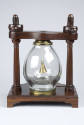


Benjamin Martin
Date: 1764
Accessories: small brass scope with brass and ivory holder.
Object number: 0007

Benjamin Martin
Date: circa 1766
Accessories: rope cord belt
glass globe
conducting pad
in folder: photographs, page containing description, history, and discussion of design, note from Ebenezer Gay regarding conservation work, excerpt from David Pingree Wheatland and I. Bernard Cohen, A Catalogue of Some Early Scientific Instruments at Harvard University (Cambridge, MA: Harvard University, 1949), woodcut with picture of instrument from B. Martin, Young Gentleman and Lady's Philosophy (1759): 139.
X-ray images of parts of the machine can be found in C1-A7.
Object number: 0013

See also/See also

Parent/Child
