


stage centering glass
Date1896
Inventory Number2006-1-0114c
ClassificationMicroscope Slide
Subject
Maker
Carl Zeiss, Optische Werkstätte, Jena
1846 - 1904
Maker
Carl Zeiss (company timeline)
founded 1846
Owner
Lydia Rabinowitsch-Kempner
1871 - 1935
Cultural Region
Place of Origin
Place of Use
Dimensionsstage centering glass: 27.7 x 19 cm (10 7/8 x 7 1/2 in.)
case: 2 x 9.1 x 4.5 cm (13/16 x 3 9/16 x 1 3/4 in.)
instruction sheet: 41 x 23.5 x 24.5 cm (16 1/8 x 9 1/4 x 9 5/8 in.)
case: 2 x 9.1 x 4.5 cm (13/16 x 3 9/16 x 1 3/4 in.)
instruction sheet: 41 x 23.5 x 24.5 cm (16 1/8 x 9 1/4 x 9 5/8 in.)
Material
Accessoriesinstruction sheet; case
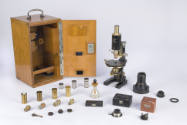
Description2006-1-0114c is a stage centering glass for use with a Zeiss mechanical stage, like 2006-1-0114b, which accompanied a Zeiss stand Ia laboratory monocular compound microscope (2006-1-0114a). This centering glass is presently stored in the parts box of that microscope.
The stage centering glass is a rectangular glass slide with a cross ruled on it. It also has two paper labels. The one on the right reads: "Carl Zeiss / opt. Werkstaette / Jena. / No. ...." The one on the left reads: "Der Tisch / ist centrirt, wenn / der Nonius / I auf .... / II [auf] .... / steht." The dotted lines are sometimes filled in with numbers once the centering glass is calibrated to a given mechanical stage whose serial number would be written on the right-hand label.
A small rectangular box covered with dark maroon leather and lined with black velvet holds a stage centering glass. It is signed, "KREUZTISCH- / CENTRIRGLAS" and "C. ZEISS JENA" in gold lettering.
An instruction sheet for its use is folded up on the parts box. It is entitled, "Benutzung des Strichkreuz-Objectträgers zur schnellen Centrirung des beweglichen Objecttisches." It is written in German and is dated 1896. A scan is attached to this file.
The stage centering glass is a rectangular glass slide with a cross ruled on it. It also has two paper labels. The one on the right reads: "Carl Zeiss / opt. Werkstaette / Jena. / No. ...." The one on the left reads: "Der Tisch / ist centrirt, wenn / der Nonius / I auf .... / II [auf] .... / steht." The dotted lines are sometimes filled in with numbers once the centering glass is calibrated to a given mechanical stage whose serial number would be written on the right-hand label.
A small rectangular box covered with dark maroon leather and lined with black velvet holds a stage centering glass. It is signed, "KREUZTISCH- / CENTRIRGLAS" and "C. ZEISS JENA" in gold lettering.
An instruction sheet for its use is folded up on the parts box. It is entitled, "Benutzung des Strichkreuz-Objectträgers zur schnellen Centrirung des beweglichen Objecttisches." It is written in German and is dated 1896. A scan is attached to this file.
Signedstamped in gold on the case: C. ZEISS JENA
printed on label on centering glass: Carl Zeiss / opt. Werkstaette / Jena.
printed on instruction sheet: CARL ZEISS, optische Werkstaette, JENA.
FunctionThe stage centering glass enables the user of the microscope to center the opening in the mechanical stage and calibrate the x-y position readings on the stage's verniers for the center.
ProvenanceLydia Rabinowitsch-Kempner, Berlin, circa 1898-1935; Robert Kempner, Berlin, 1935-1949; Walter Kempner, Durham, NC, 1949-1997; gift to CHSI, 2006.
Historical AttributesThis microscope was original owned by Lydia Rabinowitsch-Kempner, an eminent bacteriologist and a research associate of Robert Koch in Berlin at his Institute for Infectious Diseases. In 1895 she went to the Women's Medical College of Pennsylvania in Philadelphia, where she was appointed the first director of the Bacteriological Laboratory. She married Dr. Walter Kempner in Berlin in 1898 while working again with Koch. She collaborated with Koch until his death in 1910. Rabinowitsch-Kempner was the first woman ever to hold the title of professor in Prussia. Her specialization was the bacteriology of tuberculosis.
When she died, the microscope stayed in her house in Germany until 1949. Her son, Robert Kempner (who was a prosecutor at the Nuremberg Trials) sent the microscope to his brother, Walter Kempner, who lived in the US in Durham, NC (he was professor of medicine at Duke University). When the latter died in 1997, the microscope was passed to an heir. It was given to CHSI in 2006.

Carl Zeiss, Optische Werkstätte, Jena
Date: circa 1898
Accessories: oculars (4): 2, 4, and compensating oculars 6, 8; objectives: AA, DD, a2, and apochromat HI 2.0 mm; triple nosepiece; swing-out condenser with iris-cylinder diaphragm; disk diaphragm and central stop diaphragm; filter; eyepiece micrometer, brush, spare stage clips; large mechanical stage (2006-1-0114b); centering glass (2006-1-0114c) with instructions; magnification tables (2); standing case; key; leather traveling case (2006-1-0114d).
Object number: 2006-1-0114a

Carl Zeiss, Optische Werkstätte, Jena
Date: circa 1899
Accessories: case
Object number: 1997-1-1873

Wild Heerbrugg Ltd.
Date: 1960
Object number: 1997-1-0722

Carl Zeiss Jena
Date: 1914
Accessories: objectives (2): HI 90 / 1.25, 16mm / .30; collar for photography (1309u); accessories box (1309j); quadruple nosepiece.
Object number: 1309i

Ernst Leitz (company)
Date: circa 1937
Accessories: standard eyepieces (3): 8X P, Periplan. OK 10X, and Periplan. Ok. 25X; wide eyepieces (3): 1, 1, 8X, 10X; objectives (4) in fitted case: 1b 4.3X, 3 10X, P7 62X, P 1/12 oel; waveplates (2); condenser with polarizer; mechanical stage; loupe 6x; box of cover glasses; standing case; key; objective adaptors (4); and watch keys (2)
Object number: 1999-1-0020a

Carl Zeiss, Optische Werkstätte, Jena
Date: circa 1898
Object number: 2006-1-0114b

Carl Reichert
Date: circa 1879
Accessories: 5 objectives: Hartnack # 4, 7, 8, No. II Hom. Imm. No. 2 in Hartnack case; Homog. Oil immersion by Reichert in own case. 2 oculars: 2, 3; 2 disc diaphrams, 3 cup diaphrams which fit in sliding plate, sliding plate and holder for diaphrams; condenser; revolving nose piece; extra frame for mirror on slider; fitted case; key to case.
Object number: 1077a

Ernst Leitz (company)
Date: circa 1919
Accessories: oculars (2): 3, 8x; accessory box; Leitz objectives (5); wrenches (2); ground glass; N.A. 1.45 condensor cap; Abbe condensor; rotary stage; case
Object number: 1345
Carl Zeiss, Optische Werkstätte, Jena
Date: circa 1902
Accessories: oculars (5); objectives (5); microplanar objectives (2); iris diaphragm; abbe condenser; collars and sleeves for photography; parts box; Leitz object micrometer (1308b); cardioid condenser (1308d); immersion oil bottle (1308c) ; Leitz erecting prism (1308e); standing case with key
Object number: 1308a

Spencer Lens Company
Date: circa 1920
Accessories: Spencer objectives (3): 16, 4, 1.8 mm; Zeiss objective a*; Bausch & Lomb objective 1 1/2 "; filters (2); oculars (2): 6x, 10x; Abbe condenser; standing case
Object number: 1312

Carl Zeiss Jena
Date: circa 1910
Accessories: ocular: K 20x ; objectives (3): Zeiss 2 mm HI, Zeiss 40 apochromat, B&L 10x apochromat; Abbe condenser; iris diaphragm; standing case
Object number: 1365

R. & J. Beck
Date: 1876
Accessories: oculars (2) in microscope; Darker's selenite retarding filters (3); wheel diaphragm; mechanical rotary stage; stage slider. Other accessories are in the case (1122b), including monocular draw tube; oculars (3); objectives in cans (5); empty can; Lieberkühn; polarizing set; slides; camera lucidas (2); etc.; plus a Beck patent substage condenser (1122c); and apertometer (1122d).
Object number: 1122a


