


liquid prismatic compass
Datecirca 1920
Inventory Number5100
ClassificationPrismatic Compass
Subject
Maker
C. F. Casella & Co. Ltd.
founded 1905
User
Institute of Geographical Surveying, Harvard University
circa 1930
User
Institute of Geographical Exploration
1929 - 1952
Cultural Region
Place of Origin
Place of Use
DimensionsCompass: 3.2 × 7.7 × 10.3 cm (1 1/4 × 3 1/16 × 4 1/16 in.)
carrying case: 4.2 × 8.7 × 12.9 cm (1 5/8 × 3 7/16 × 5 1/16 in.)
carrying case: 4.2 × 8.7 × 12.9 cm (1 5/8 × 3 7/16 × 5 1/16 in.)
Material
Accessoriesleather carrying case; long leather strap with brass loop at end
DescriptionLiquid compass in brass case, with prism attachment.
The compass has a white card. The cardinal and intercardinal points are marked on the card. Outside these is a scale with values ranging from 0 to 360, graduated into fives. Around the outer circumference of the card is an aluminum scale with values ranging from 0 to 360, graduated into ones. A double sided needle hovering over to compass points to magnetic north and south. The broader end, with a white arrow painted on it, points north; the narrower end points south. A clear liquid fills the compass chamber.
Just under the surface of the compass's glass cover is a white scale with values ranging from 0 to 36, graduated into halves. This scale, together with a white index line painted on the glass, may be adjusted by turning the brass ring on the side of the compass case. A pointed brass tab may be tightened and loosened against the ring by turning a knurled knob in the center of the tab. The white scale is read off an aluminum tab marked with a single line that projects out from under the scale at the top center of the compass.
Clamped around the center of the case is a second brass ring marked with the cardinal and primary and secondary intercardinal points.
In the center of the lid of the case is a glass circle, marked with a black line that serves as a sight line when the lid is open. A rectangular piece projecting from the side of the lid covers a prism attachment. The prism attachment, which is bolted to the side of the case, itself folds up over the compass when in use. A brass ring is looped through the base of the prism attachment.
The back of the compass case, which is mostly covered in black enamel, is decorated with a painted red ring.
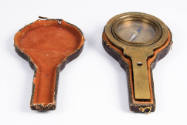
The compass is stored in a brown leather carrying case. The body of the carrying case is semi-circular, with contrasting stitching. A leather strap wrapping around the carrying case from bottom to top keeps it closed. A much longer strap, which ends in a brass loop, is threaded through a leather loop on the side of the carrying case.
The compass has a white card. The cardinal and intercardinal points are marked on the card. Outside these is a scale with values ranging from 0 to 360, graduated into fives. Around the outer circumference of the card is an aluminum scale with values ranging from 0 to 360, graduated into ones. A double sided needle hovering over to compass points to magnetic north and south. The broader end, with a white arrow painted on it, points north; the narrower end points south. A clear liquid fills the compass chamber.
Just under the surface of the compass's glass cover is a white scale with values ranging from 0 to 36, graduated into halves. This scale, together with a white index line painted on the glass, may be adjusted by turning the brass ring on the side of the compass case. A pointed brass tab may be tightened and loosened against the ring by turning a knurled knob in the center of the tab. The white scale is read off an aluminum tab marked with a single line that projects out from under the scale at the top center of the compass.
Clamped around the center of the case is a second brass ring marked with the cardinal and primary and secondary intercardinal points.
In the center of the lid of the case is a glass circle, marked with a black line that serves as a sight line when the lid is open. A rectangular piece projecting from the side of the lid covers a prism attachment. The prism attachment, which is bolted to the side of the case, itself folds up over the compass when in use. A brass ring is looped through the base of the prism attachment.
The back of the compass case, which is mostly covered in black enamel, is decorated with a painted red ring.
The compass is stored in a brown leather carrying case. The body of the carrying case is semi-circular, with contrasting stitching. A leather strap wrapping around the carrying case from bottom to top keeps it closed. A much longer strap, which ends in a brass loop, is threaded through a leather loop on the side of the carrying case.
Signedstamped on compass case lid, top center: INSTITUTE OF GEOGRAPHICAL SURVEYING HARVARD UNIVERSITY
Inscribedstamped on top of prism cover: H.R.;
stamped on back of compass case, center: PATENTS / 29611/10. / 14083/13. / 10002 / 16.;
stamped on back of compass case, center: No 6309
FunctionUsed to determine the direction of the sight line between the user and a particular object, with respect to magnetic north.
The user first opens the lid of the case, then flips the prism attachment over the compass. He sights the object in question through the prism attachment, centering it on the sight line on the case lid. Holding the compass in place, he rotates the top brass ring until the index line painted on the glass cover coincides with the arrow pointing north. He then sights the object a second time, reading, with the help of the prism, the degree value on the topmost ring to which the aluminum indicator points. This indicates the direction, in degrees from north divided by ten, of the object.
The water inside the compass case dampens the magnetic needle and thus reduces its tendency to wobble.
The user first opens the lid of the case, then flips the prism attachment over the compass. He sights the object in question through the prism attachment, centering it on the sight line on the case lid. Holding the compass in place, he rotates the top brass ring until the index line painted on the glass cover coincides with the arrow pointing north. He then sights the object a second time, reading, with the help of the prism, the degree value on the topmost ring to which the aluminum indicator points. This indicates the direction, in degrees from north divided by ten, of the object.
The water inside the compass case dampens the magnetic needle and thus reduces its tendency to wobble.
ProvenanceBelonged to the Institute of Geographical Surveying at Harvard University.

John Frederick Newman
Date: circa 1835
Accessories: mahogany case with brass hinges and hooks
Object number: 5239

Troughton & Simms
Date: circa 1840
Accessories: mahogany box with brass handle; sun shade for telescope
Object number: 5234

Peter & John Dollond
Date: 1780-1800
Accessories: mahogany box with brass hooks, hinges, and handle; tripod (see 5240b)
Object number: 5240a

Troughton & Simms
Date: circa 1840
Accessories: mahogany box with brass hinges and hooks
Object number: 5232

Spencer, Browning & Rust
Date: circa 1800
Accessories: mahogany case with brass hooks and hinges; lens cap
Object number: 5137

William Fraser
Date: circa 1785
Accessories: in a small yellow (chamois?) pouch, perhaps not original
Object number: DW0619
Joseph Czech
Date: circa 1780
Accessories: fitted leather case with plush lining and brass clasp
Object number: DW0134


Keuffel & Esser Company
Date: early 20th century
Accessories: rectangular brown leather case
Object number: 1998-1-1656

Buff & Buff Manufacturing Company
Date: circa 1905
Accessories: wood case; leather case; right-angle prism; plumb bob; oil flask; tripod (5174b)
Object number: 5174a