


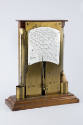

Lowe's graphical hygrometer
Datecirca 1880
Inventory Number1998-1-1570
ClassificationHygrometer
Subject
Maker
E. Ducretet & Cie
1864 - 1931
User
Department of Physics, Harvard University
founded 1884
Cultural Region
Place of Origin
Dimensions29 x 25 x 10 cm (11 7/16 x 9 13/16 x 3 15/16 in.)
Material
Bibliography
DescriptionA brass and mahogany stand on the sides which two thermometers are mounted. Both thermometers are made of glass with elegant brass scales that are screwed to the stand. Both thermometers have a similar length but the one on the right has its mercury bulb wrapped in cotton.
On the front of the stand between the thermometers is a porcelain chart that relates the temperature on both thermometers with values of relative humidity and dewpoints.
There is a brass index that can move over the chart. It can be raised on a vertical rail in the middle of the stand, its height corresponding to a temperature reading on a scale to the left of the chart with two pointers. The upper pointer on this scale is controlled by the height of the index. The distance from the upper to the lower pointer on this scale is controlled by the turning the index on its pivot.
An old Harvard label numbered "8.8.1" is attached on the base. The number "20 2" is stamped in black on the brass face. "H7" has been painted in white on the base.
On the front of the stand between the thermometers is a porcelain chart that relates the temperature on both thermometers with values of relative humidity and dewpoints.
There is a brass index that can move over the chart. It can be raised on a vertical rail in the middle of the stand, its height corresponding to a temperature reading on a scale to the left of the chart with two pointers. The upper pointer on this scale is controlled by the height of the index. The distance from the upper to the lower pointer on this scale is controlled by the turning the index on its pivot.
An old Harvard label numbered "8.8.1" is attached on the base. The number "20 2" is stamped in black on the brass face. "H7" has been painted in white on the base.
Signedbase is stamped: E DUCRETET & Cie A PARIS
Inscribedon porcelain chart: HYGROMÈTRE / GRAPHIQUE DE / LOWE
on porcelain chart: HUMIDITÉ RELATIVE [x axis]; POINT DE ROSÉE [y axis]
FunctionThis is an instrument that determines the relative humidity and dew point of the air indirectly, by making use of the different readings of a dry bulb and a wet bulb thermometer. Most instruments of this kind include a table in which the user would need to look for the intersection of a dry bulb and wet bulb thermometer reading to obtain the relative humidity. This particular hygrometer however includes a graphic device that simplifies this process.
By adjusting the pointers on the temperature scale to the left of the chart, the upper one to the temperature to the dry bulb thermometer, the lower one to the temperature of the wet bulb thermometer, the device will automatically point to the values for relative humidity and dew point temperature. The height of the pointers determines the height of the index on the chart. The distance between the pointer rotates it.
Here is a description from the Quarterly Journal of the Royal Meteorological Society, June 16th, 1875:
"Mr, Lowe has fitted a graphical table on the same framework with the two thermometers, which enables the observer to find speedily the quantity he wants. To find the actual temperature, read the left hand or dry bulb thermometer. To find the sensible temperature, or temperature due to evaporation, read the right hand or wet bulb thermometer.
To find the relative humidity take hold of the knob in front of the instrument, and slide it up or down, as the case may be, until the lower edge of the upper pointer coincides with the auxiliary scale in degrees and fraction of degrees with the observed temperature on the dry bulb thermometer, then by turning the knob by the right or left, bring the upper edge of the lower pointer to coincide in degrees and fraction of degrees, upon the auxiliary scale, with the observed temperature of the wet bulb thermometer.
The instrument is now adjusted, and the relative humidiry, dew point and absolute amount of moisture will be indicated by the index upon the nearly vertical lines; let the eye follow this line to the top of the dial, and under "relative humidity" will be found numbers which give the percentage of humidity sought.
Observe upon the dial the diagonal line upon which the end of the index hand rests; let the eye follow it down to the last vertical line of the dial, and the numbers there indicate the dew-point sought.
Upon these lines, also, will be found a number which gives in grains and tenths the weight of water (in form of vapour) in each cubic foot of air, and also another column, giving the force of vapour in inches and tenths."
By adjusting the pointers on the temperature scale to the left of the chart, the upper one to the temperature to the dry bulb thermometer, the lower one to the temperature of the wet bulb thermometer, the device will automatically point to the values for relative humidity and dew point temperature. The height of the pointers determines the height of the index on the chart. The distance between the pointer rotates it.
Here is a description from the Quarterly Journal of the Royal Meteorological Society, June 16th, 1875:
"Mr, Lowe has fitted a graphical table on the same framework with the two thermometers, which enables the observer to find speedily the quantity he wants. To find the actual temperature, read the left hand or dry bulb thermometer. To find the sensible temperature, or temperature due to evaporation, read the right hand or wet bulb thermometer.
To find the relative humidity take hold of the knob in front of the instrument, and slide it up or down, as the case may be, until the lower edge of the upper pointer coincides with the auxiliary scale in degrees and fraction of degrees with the observed temperature on the dry bulb thermometer, then by turning the knob by the right or left, bring the upper edge of the lower pointer to coincide in degrees and fraction of degrees, upon the auxiliary scale, with the observed temperature of the wet bulb thermometer.
The instrument is now adjusted, and the relative humidiry, dew point and absolute amount of moisture will be indicated by the index upon the nearly vertical lines; let the eye follow this line to the top of the dial, and under "relative humidity" will be found numbers which give the percentage of humidity sought.
Observe upon the dial the diagonal line upon which the end of the index hand rests; let the eye follow it down to the last vertical line of the dial, and the numbers there indicate the dew-point sought.
Upon these lines, also, will be found a number which gives in grains and tenths the weight of water (in form of vapour) in each cubic foot of air, and also another column, giving the force of vapour in inches and tenths."
ProvenanceThe label under the base states that this instrument was found in the Jefferson Laboratory (Department of Physics, Harvard) Prep Room on 3/13/67.

Alexander G. McAdie
Date: 1915-1920
Object number: 1998-1-0831

French
Date: 1850-1890
Accessories: set includes: brass stand base; T-shaped tube; hollow tube with side neck; tube with ring stands; brass holder for two thermometers; one thermometer; glass tubes with brass bottoms (2); felt lined, fitted case
Object number: 3825

French
Date: 1850-1890
Accessories: set includes: thermometers (2); brass stand base; silver vessels on a T tube (2); curved glass tube with cork; stand tube with side neck; stand tube with holder for curved glass tube; brass clamp for thermometers
Object number: 3824
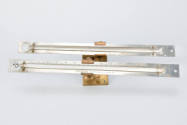
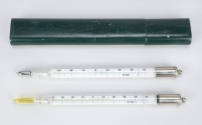
Rudolf Fuess
Date: circa 1858
Accessories: metal case
Object number: DW0789

Department of Chemistry, Harvard University
Date: circa 1952
Accessories: a hinged wooden case with hook closures, and a paper insert
Object number: 1998-1-0828

Taylor Instrument Companies
Date: circa 1930
Accessories: chart "RELATIVE HUMIDITY" in holder stored in file folder
Object number: 1998-1-0285

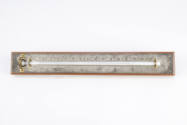

J. D. Edwards
Date: circa 1835
Object number: 1998-1-1439


American
Date: 1900-1950
Accessories: carrying cases (2)
Object number: 1998-1-1259