


dip circle
Date1765
Inventory Number0026
ClassificationDip Needle
Subject
Attributed to
Edward Nairne
1726 - 1806
User
John Winthrop
1714 - 1779
User
Samuel Williams
1743 - 1817
Cultural Region
Place of Origin
Place of Use
Dimensions35 x 32 x 26.5 cm (13 3/4 x 12 5/8 x 10 7/16 in.)
circle diam: 28.2 cm (11 1/8 in.)
circle diam: 28.2 cm (11 1/8 in.)
Material
AccessoriesSmall magnifying glass on end of box to assist in aligning the dip needle.
Bibliography
DescriptionThis instrument is made of a brass circle mounted on vertically on a round brass circular base. The base has a copper level and is supported by three feet, which have each a leveling screw. The whole instrument can rotate on its base with the help of a tangent screw.
There is an engraved scale around the vertical circle, marked by single degrees and subdivided every 30'. It is numbered by tens in the following way: 30°-0°- 90°-0°-30°, the zeros matching up at horizontal diameter. The index arm with vernier pivots on center of circle. The magnetic needle is mounted on knife-edge pivots and is enclosed in a rectangular brass box with copper edges, silvered base and glass cover.
A small copper magnifying glass is attached at the upper end of the box to assist in aligning the needle. Some screws have small pre-determined punched dots for dismantling purposes. A very uncommon instrument by Nairne.
There is an engraved scale around the vertical circle, marked by single degrees and subdivided every 30'. It is numbered by tens in the following way: 30°-0°- 90°-0°-30°, the zeros matching up at horizontal diameter. The index arm with vernier pivots on center of circle. The magnetic needle is mounted on knife-edge pivots and is enclosed in a rectangular brass box with copper edges, silvered base and glass cover.
A small copper magnifying glass is attached at the upper end of the box to assist in aligning the needle. Some screws have small pre-determined punched dots for dismantling purposes. A very uncommon instrument by Nairne.
In Collection(s)
Signedon base: Nairne London
Curatorial RemarksXRF analysis of the metals was done by Katherine Eremin and Sara Schechner in August 2007.
FunctionThis kind of instrument is used to measure the inclination (or dip) of the earth's magnetic field. A compass needle has two motions: horizontal (to determine the magnetic north) and vertical, towards the center of the earth, what is called inclination or dip of the needle. Since the magnetic poles shift gradually and irregularly, these two motions varies with time and according to where you stand at the surface of the earth. For an accurate picture of the earth's magnetism, these two motions need to be taken into account. The dip circle can measure precisely the magnetic inclination on a day-to-day basis.
ProvenanceJefferson Physical Laboratory, Harvard University; transferred to CHSI May 1948.
Historical AttributesThis instrument was the fourth magnetic instrument bought by Harvard from Nairne in 1765. It was also the most expensive, costing £18.3.0. It came in a mahogany box lined with green cloth, lock and key. It has been lost since then.
At Harvard, Samuel Williams, the Hollis Professor, assisted by Stephen Sewall, the Hancock Professor of Hebrew and other Oriental Languages, published readings taken on this instrument (and the variation compass, 0025) in the first volume of the Memoirs of the American Academy of Arts and Sciences (1785).
Before the fire destroyed Harvard's apparatus in 1764, Harvard had received a dip needle from John Hancock of Boston in late 1761 or early 1762. Thanks were given by the Corporation on January 5, 1762. (see related references)


American
Date: early 20th-mid 20th Century
Accessories: wooden box to hold dip needles
Object number: 1998-1-1428

Barthélémy Urbain Bianchi
Date: ca. 1840
Accessories: housed in pine box
Object number: 5212

Henri Gambey
Date: circa 1835
Accessories: cover (square wood frame with glass panes); spare needle in separate box stamped "8-22" (Inv # 1990-2-0001b)
Object number: 1990-2-0001a
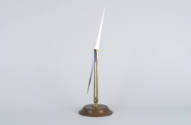

Kelvin Bottomley & Baird Ltd.
Date: circa 1910
Accessories: mahogany case
HUSUN catalogue (in instrument file)
Object number: 5335c


W. & L. E. Gurley
Date: 1950
Accessories: leather carrying pouch
Object number: 1996-1-0638


Claude-Siméon Passemant
Date: 1749-1769
Accessories: ocular; objectives (7); bull's eye condenser; Lieberkühn for stage mounting; cone diaphragm; spring frame for slides; frog plate; stage forceps; large and small black and white disks (2); round micrometer slide with fine wire screen; low-power lens; black aperture disk; brass slider for 4 specimens; ivory slides--rectangular (6); ivory slides--circular (2); brass slide with aperture to hold circular ivory slides; boxes (2) of round ivory slides (40 in total).
Object number: 1182
