


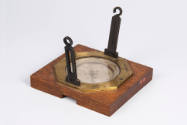
azimuth compass
Datecirca 1765
Inventory Number0095
ClassificationCompass
Subject
Maker
Edward Nairne
1726 - 1806
Maker
Daniel Scatliff (I)
fl. 1760 - 1767
User
John Winthrop
1714 - 1779
User
Samuel Williams
1743 - 1817
Cultural Region
Place of Origin
Place of Use
Dimensions23.5 x 32 x 28 cm (9 1/4 x 12 5/8 x 11 in.)
bezel and gimbal ring diam: 24 cm (9 7/16 in.)
bezel and gimbal ring diam: 24 cm (9 7/16 in.)
Material
Bibliography
DescriptionThis compass is mounted in brass gimbals and installed in a Wainscott box on a short post allowing the bowl and sighting vanes to move together. The azimuth with slit and hair sights rotates on the compass rim. The compass card is printed with a fleur-de-lys pointing north and is decorated in the east direction. The outer edge of the printed card is marked in degrees, by increments of tens. The card is held in place by a silvered brass circle, marked every 30' and numbered in tens.
The paint color and lead weight on this instrument are identical to another one by Nairne in the collection (# 0094). The compass and its gimbals may be removed from the box and mounted on a post or railing to facilitate the use of the azimuth sights.
The paint color and lead weight on this instrument are identical to another one by Nairne in the collection (# 0094). The compass and its gimbals may be removed from the box and mounted on a post or railing to facilitate the use of the azimuth sights.
Signedon gimbals: E. NAIRNE LONDON
on compass card: Made by Daniel Scatliff Near Old Stairs Wapping
Inscribedstamped on box: 8-21
painted on box: MA9
Curatorial RemarksThe following information helps in dating this instrument: on 2 October 1760, Daniel Scatliff received a patent (#752) for a Quadrant for taking observations at sea.
FunctionMarine or azimuth compasses determined the sun's azimuth in order to correct for magnetic declination of the compass. They were used for steering the ship on course.
Historical AttributesAn "Azimuth Compass best sort in Wainscott box ... 5.15.6" appears directly below the mariners' compass (# 0094) on Joseph Mico's August 1765 invoice of apparatus purchased by Harvard College from Edward Nairne.
Professor Samuel Williams may have taken this azimuth compass on his expedition to observe a total solar eclipse in October 1780 behind enemy lines in Penobscot Bay, Maine.

Samuel Thaxter & Son
Date: 1825-1843
Object number: DW0519


E. S. Ritchie & Sons
Date: 1919
Accessories: case
Object number: 5330b



Henry Hughes & Son, Ltd.
Date: circa 1915
Object number: 5335a


E. S. Ritchie & Sons
Date: 1919
Accessories: azimuth circle (5330b)
Object number: 5330a

