


Hipp-type chronoscope
Datecirca 1893
Inventory NumberWJ0044
ClassificationChronoscope
Subject
Manufacturer
Peyer, Favarger & Cie
fl. 1889 - 1923
Cultural Region
Place of Origin
Place of Use
Dimensions59 x 26 x 22 cm (23 1/4 x 10 1/4 x 8 11/16 in.)
Material
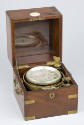
DescriptionThe instrument is mounted on four wooden decorative columns. A weight drives the clock mechanism. The four electrical connectors on the base are used to power the electromagnets that release the clutch controlling the moving hands on the dial. Two small ropes hanging on the left side also control the mechanical movement of the gears. A removable oblong-shape glass cover goes over the clock mechanism.
A weight rotates the drum and starts the movement of this weight-driven mechanism. An electromagnet releases the clutch that holds the rotating hands away from the turning drum and then starts the rotation of the two measuring hands. A second electromagnet causes the clutch to re-engage, thus stopping the hands. With proper calibration, measurements of up to 1/1000th of a second were possible.
A weight rotates the drum and starts the movement of this weight-driven mechanism. An electromagnet releases the clutch that holds the rotating hands away from the turning drum and then starts the rotation of the two measuring hands. A second electromagnet causes the clutch to re-engage, thus stopping the hands. With proper calibration, measurements of up to 1/1000th of a second were possible.
In Collection(s)
Signedon dial: Peyer, Favarger & Cie / Neuchâtel Suisse / N. 14453
FunctionThe Hipp chronoscope was used primarily as a timing device for reaction time experiments (time measurement of mental acts).
ProvenancePsychology Department, William James Hall, Harvard University.
Historical AttributesThis instrument is found in Hugo Münsterberg's 1893 <i>Psychological Laboratory of Harvard University</i> document. It is thus listed: "125. Hipp's chronoscope, measuring one-thousandth part of a second. By Peyer, Favarger & Co., Neufchatel. $71."
See online reproduction <a href="http://psychclassics.yorku.ca/Munster/Lab/" target="_blank">here</a>.

E. Zimmermann
Date: 1890-1910
Accessories: weights, crank, extra tuning fork
Object number: WJ0105


William Bond and Son
Date: circa 1864
Accessories: Winding key
Object number: 2502


Charles Frodsham
Date: circa 1865
Accessories: winding key.
Object number: 1998-1-1319
William Bond and Son
Date: circa 1860
Accessories: carrying case
Object number: 2005-1-0015a


John Cuthbertson
Date: 1770-1815
Accessories: brown storage box, descriptive tag, thin strip of paper in box with the inscription "lucernal microscope" in David P. Wheatland's handwriting (which refers to figs. 47-48 and 51 in this series), page from the book "Old Science and Medicine" with a photographic copy of the first print from this series, entitled "The Large Electric Machine at Haarlem."
Object number: 1998-1-1087

Ralph Gerbrands Company
Date: circa 1950
Accessories: bob hanging by green thread on side; black and red power cord; spare fastening pins in envelope; spare roll of paper
Object number: 1999-1-0004

Institute of Geographical Exploration
Date: circa 1900
Accessories: winding key; geared allen wrench; leather holster. Associated with printing chronograph.
Object number: DW0471a

