


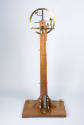


Wundt-type complication apparatus
Datecirca 1893
Inventory NumberWJ0051a,b,c
ClassificationComplication apparatus
Subject
Maker
Carl Krille
Cultural Region
Place of Origin
Place of Use
Dimensions137 x 59 x 37 cm (53 15/16 x 23 1/4 x 14 9/16 in.)
dial diam.: 32.4 cm (12 3/4 in.)
dial diam.: 32.4 cm (12 3/4 in.)
Material
Accessoriesbrass pendulum weight
DescriptionThree brass leveling screws are on the base of the instrument. Four feet hold upright the central support pillar. On it is found a weight-driven clocklike mechanism designed to move the pointer back and forth over the large circular dial. The original pendulum rod is missing; this one is a replacement made in 1992. The dial is numbered 0-180-0, divided in fives but with number increments in tens. A brass circular pendulum weight can be moved up and down to regulate the pendulum's swing.
The most intricate aspect of this instrument is the mechanism that controls the bell. Powered by electricity, it can be (precisely) adjusted so as to sound as the pointer passes any given point on the scale.
The most intricate aspect of this instrument is the mechanism that controls the bell. Powered by electricity, it can be (precisely) adjusted so as to sound as the pointer passes any given point on the scale.
In Collection(s)
Signedon front case of pendulum mechanism: C. KRILLE / LEIPZIG
Inscribedon base: 726
on support pillar, front and back: 726
FunctionThis instrument was used to measure the effect of attention on judgements of prior entry. A subject who pays attention to a visual cue (the numbers on the large dial) has a delayed reaction to an auditory cue (the sound of the bell), and vice versa.
Historical AttributesThis instrument is found in Hugo Münsterberg's 1893 <i>Psychological Laboratory of Harvard University<i/> document. It is thus listed: "174. Instrument for studying the complication of perceptions. After Wundt, by Krille, Leipzig. $38."
See online reproduction <a href="http://psychclassics.yorku.ca/Munster/Lab/" target="_blank">here</a>
It would be interesting to know how this instrument performed at Harvard in the late 1890s. In the <i>Mind</i> article mentioned in the related works, an anonymous reviewer writes: "Here are five pendulums by Krille (if the reviewer's two be counted), and one by Zimmermann. All five of the former are subject, for one reason or another, to severe criticism. The Zimmermann machine is only 'fairly satisfactory.' The fact, then, seems to be that the design of the instrument, though meritorious in the first instance, is one that an improved technique and a wider range of problems render out-of-date; that the workmanship, in most cases, is distinctly poor; and that a desire to put a fairly cheap piece upon the market has further led to the use of poor materials." (p.288)

S. C. Tisley & Company
Date: circa 1880
Accessories: three weights for pendulum
Object number: 1997-1-0451

George Washington Pierce
Date: 1920-1928
Accessories: Inside the clock: long pendulum staff; cylindrical brass weight; knob; an installation plan.
in accessories box of master clock RS0116a: some of the suspension and electrical contacts are for the slave clock.
Object number: RS0116b

Synchronome Company, Ltd
Date: circa 1929
Object number: 1998-1-0187b


W. & S. Jones
Date: circa 1804
Object number: 0077b


William Hamilton Shortt
Date: circa 1929
Object number: 1998-1-0187a