


arithmometer
Datecirca 1860
Inventory Number1990-5-0026
ClassificationCalculating Machine
Subject
Maker
Thomas de Colmar
1785 - 1870
User
Blue Hill Meteorological Observatory
1885-present
Cultural Region
Place of Origin
Dimensions17.8 x 58.5 x 9 cm (7 x 23 1/16 x 3 9/16 in.)
Material
Accessoriestwo instruction books (in French) dated 1856, 1860; explanatory article by F. Reuleaux (in German) dated 1892
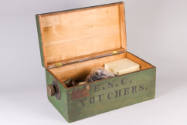
DescriptionThis Thomas de Colmar Arithmometre is encased in a rectangular wooden box with a lid attached to long, back edge with three hinges. The brass faceplate covers the entire interior bottom half of the box and is nearly flush with the walls. Along the top of the face plate there are sixteen brass dials. Behind each dial is a small, black, half-circle depression into the brass. At the bottom of each dish is a hole revealing a white number from 0 - 9. At either end of the 16 brass dials is a larger black dial.
On the right side of the face plate are eight vertical tracks, each supporting a brass slider with a small arrow pointing to the left. To the left of each track, the numbers from 0 to 9 are engraved, with 9 at the top and 0 at the bottom. The brass sliders can be set to any of the nine digits. The sliders are used to input the number upon which the calculation will be performed.
In between the eight tracks and the sixteen brass dials is another set of nine brass dials. Beneath each of these dials is a black, concave display for a white number between 0 and 9. These black circles are smaller than the ones above.
To the left of the eight slider tracks is a storage box with a white door and small knob. Inside the storage box is a paper envelope containing some small white plastic knobs and a piece of broken glass. Underneath the envelope is a piece of glass with a small piece missing that matches the one in the envelope.
In between the eight slide rails and the white storage box is another rail supporting a white plastic knob. To the right of the top of the track is engraved "ADD'ON ET MULTI'ON". To the right of the bottom of the track is engraved "SOUST'ON ET DIVIS'ON". The white knob can be set in either of these two positions.
To the right of the eight tracks is a brass crank with a white handle on one end. The handle is on a hinge and can be flipped up to facilitate cranking. On the outside of the front of the box is a dark metal key hole. The top half of the box has a small brass strip with two pegs attached to the rim. The bottom has a brass strip with two holes on the rim. The pegs fit into the holes when the box is closed. Similarly, the top half of the box has two differently sized wooden pieces cut into the walls that insert into equally sized holes cut into the walls on either side of the bottom half of the box.
To see Thomas de Colmar's English patent application, complete with pictures of his hand-drawn diagrams, click here.
On the right side of the face plate are eight vertical tracks, each supporting a brass slider with a small arrow pointing to the left. To the left of each track, the numbers from 0 to 9 are engraved, with 9 at the top and 0 at the bottom. The brass sliders can be set to any of the nine digits. The sliders are used to input the number upon which the calculation will be performed.
In between the eight tracks and the sixteen brass dials is another set of nine brass dials. Beneath each of these dials is a black, concave display for a white number between 0 and 9. These black circles are smaller than the ones above.
To the left of the eight slider tracks is a storage box with a white door and small knob. Inside the storage box is a paper envelope containing some small white plastic knobs and a piece of broken glass. Underneath the envelope is a piece of glass with a small piece missing that matches the one in the envelope.
In between the eight slide rails and the white storage box is another rail supporting a white plastic knob. To the right of the top of the track is engraved "ADD'ON ET MULTI'ON". To the right of the bottom of the track is engraved "SOUST'ON ET DIVIS'ON". The white knob can be set in either of these two positions.
To the right of the eight tracks is a brass crank with a white handle on one end. The handle is on a hinge and can be flipped up to facilitate cranking. On the outside of the front of the box is a dark metal key hole. The top half of the box has a small brass strip with two pegs attached to the rim. The bottom has a brass strip with two holes on the rim. The pegs fit into the holes when the box is closed. Similarly, the top half of the box has two differently sized wooden pieces cut into the walls that insert into equally sized holes cut into the walls on either side of the bottom half of the box.
To see Thomas de Colmar's English patent application, complete with pictures of his hand-drawn diagrams, click here.
Signedengraved on front of dial plate: THOMAS de Colmar, INVENTEUR
Inscribedengraved on front of dial plate: S'adresser / 44 RUE DE CHATEAUDUN, 44 / PARIS: NO. 2180 [in circle] EXPOSITION, 16. RUE DE LA TOUR DES DAMES
engraved on lid of case: Arithmomètre
inside storage box on a small tag: BHMO No. 1958
FunctionThe Thomas de Colmar Arithmomètre is capable of all fundamental arithmetic calculations: addition, multiplication, subtraction, division.
The number upon which a user would like to operate is input by setting the eight brass sliders on tracks to the desired digits. Note that the input number cannot be greater than eight digits. In order to perform an addition, the user must set the white plastic slider to the ADD'ION ET MULTI'ON position. The user then turns the crank until the input value is displayed in the larger set of black dishes along the top of the calculator. A numbers can be added to that number by inputting it using the brass sliders and turning the crank in the same manner. In order to subtract some number X from a number Y, Y is input using the eight sliders first. The white plastic slider is set to subtraction, and X is input second. There are knobs associated with each of the black number displays used to reset the numbers displayed to 0. The large black knob to the right of the sixteen large black number displayers is used to reset their values to 0.
The Arithmomètre is capable of multiplication and division as well because numbers entered into the second set of smaller, black number display windows will be used as multipliers or dividers. In part because of this feature, the Arithmometre is one of the first multiplication machines capable of successful commercial production.
For a complete explanation of how to perform all various arithmetic operations, see Colmar's English Patent Application.
The number upon which a user would like to operate is input by setting the eight brass sliders on tracks to the desired digits. Note that the input number cannot be greater than eight digits. In order to perform an addition, the user must set the white plastic slider to the ADD'ION ET MULTI'ON position. The user then turns the crank until the input value is displayed in the larger set of black dishes along the top of the calculator. A numbers can be added to that number by inputting it using the brass sliders and turning the crank in the same manner. In order to subtract some number X from a number Y, Y is input using the eight sliders first. The white plastic slider is set to subtraction, and X is input second. There are knobs associated with each of the black number displays used to reset the numbers displayed to 0. The large black knob to the right of the sixteen large black number displayers is used to reset their values to 0.
The Arithmomètre is capable of multiplication and division as well because numbers entered into the second set of smaller, black number display windows will be used as multipliers or dividers. In part because of this feature, the Arithmometre is one of the first multiplication machines capable of successful commercial production.
For a complete explanation of how to perform all various arithmetic operations, see Colmar's English Patent Application.
ProvenanceFrom the Blue Hill Meteorological Observatory, October 21, 1958.


Fabre et Cie
Date: circa 1856
Object number: 5470


Jakob Amsler
Date: circa 1906
Accessories: instrument is in four (4) parts; the rail is in own box and is inventory # 2006-1-0002b; letter from Prof. William Brower containing the complete history of ownership and use (missing)
Object number: 2006-1-0002a

Frank S. Baldwin
Date: 1897-1907
Accessories: instruction manual (in object file); history of instrument (both in very poor condition)
Object number: 1997-1-0246

Hammond Typewriter Company
Date: circa 1923
Accessories: four Hammond type shuttles for different type faces, each with a wooden storage box; four laminated paper rectangles with symbol placement guide; instruction book, instruction sheets, advertisements, and correspondence (in object file)
Object number: 1996-1-0373

Forster
Date: 1950-1960
Accessories: spare ink cartridges; pen attachments
am auxiliary box containing small Allen wrench, scotch tape, extra parts, and storage instructions
Object number: 1999-1-0054


Walter Balcke
Date: 1952-1964
Accessories: mahogany box; cardboard instruction card
Object number: 1997-1-1601

Fabre et Cie
Date: circa 1856
Object number: 5469
See also/See also
