


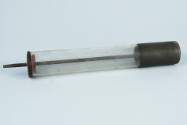
Leyden Jar (experimental)
Inventory NumberRS0177
ClassificationLeyden Jar
Subject
Maker
Corning
1851-present
Cultural Region
Place of Origin
Dimensionsbox: 40 x 15 x 14 cm (15 3/4 x 5 7/8 x 5 1/2 in.)
jar: 37.1 x 11.4 x 11.4 cm (14 5/8 x 4 1/2 x 4 1/2 in.)
jar: 37.1 x 11.4 x 11.4 cm (14 5/8 x 4 1/2 x 4 1/2 in.)
Material
DescriptionA Leyden Jar (experimental) made by Corning Glass with an insulated coating on outside and cardboard storage box.
Signedunsigned
Inscribedon cardboard box: CORNING/NOMEX/GLASS/NX/Made in U.S.A./ (illegible printing)
FunctionPossible function: The Leyden jar is a simple device that "stores" static electricity in large amounts. It was invented in 1745 by Pieter van Musschenbroek (1692–1761), in Leiden, The Netherlands. It was the original form of the capacitor. The Leyden jar was used to conduct many early experiments in electricity, and its discovery was of fundamental importance in the study of electricity. Previously, researchers had to resort to insulated conductors of large dimensions to store charge. The Leyden jar provided a much more compact alternative.
http://en.wikipedia.org/wiki/Leyden_jar
Possible origin: The first man made capacitor. The Leyden Jar consists of a glass jar, serving as a dielectric, coated inside and outside, not quite to the top with tin foil or other conductor. The top is fitted with a stopper through which passes a metal rod with a knob at the top, and below a metal chain extending down to the inner coating of tin foil. The jars were charged from static machines. The inventor was Cuneus, a pupil at Leiden who while experimenting charged a bottle of water with his electrical machine, he held a bottle with one hand and happened to touch the water with the other, he received a shock so unexpected and so unlike any thing he had ever felt before, that he was filled with astonishment. It was two days before he recovered from his fright. A few days afterward in a letter to a friend, the physicist innocently remarked, that he would not take another shock for the whole kingdom of France. The honor of the invention of the jar is also claimed for Kleist, Bishop of Pomerania who was the first to make known his discovery in writing. At least Cuneous was clearly the first person to be zapped by a Leyden Jar. The Frenchman Abbe Nollet passed a 'shock' from a battery of Leyden jars through a number of Carthusian monks, arranged in a circle 5400 feet in diameter and observed that they all jumped at the same time when 'shocked'. (Allowing for differences in their sizes and age).
http://www.plasma-art.com/goodbadsci.html#l
http://en.wikipedia.org/wiki/Leyden_jar
Possible origin: The first man made capacitor. The Leyden Jar consists of a glass jar, serving as a dielectric, coated inside and outside, not quite to the top with tin foil or other conductor. The top is fitted with a stopper through which passes a metal rod with a knob at the top, and below a metal chain extending down to the inner coating of tin foil. The jars were charged from static machines. The inventor was Cuneus, a pupil at Leiden who while experimenting charged a bottle of water with his electrical machine, he held a bottle with one hand and happened to touch the water with the other, he received a shock so unexpected and so unlike any thing he had ever felt before, that he was filled with astonishment. It was two days before he recovered from his fright. A few days afterward in a letter to a friend, the physicist innocently remarked, that he would not take another shock for the whole kingdom of France. The honor of the invention of the jar is also claimed for Kleist, Bishop of Pomerania who was the first to make known his discovery in writing. At least Cuneous was clearly the first person to be zapped by a Leyden Jar. The Frenchman Abbe Nollet passed a 'shock' from a battery of Leyden jars through a number of Carthusian monks, arranged in a circle 5400 feet in diameter and observed that they all jumped at the same time when 'shocked'. (Allowing for differences in their sizes and age).
http://www.plasma-art.com/goodbadsci.html#l


Wireless Specialty Apparatus Company
Date: circa 1908-1909
Object number: 2008-1-0117


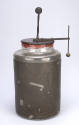

L. E. Knott Apparatus Company
Date: 1900-1930
Object number: 1997-1-1405