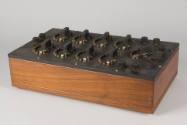
decade resistance box 102-D
Dateearly 20th Century
Inventory NumberRS0240
ClassificationResistance Box
Subject
Maker
General Radio Company
1915-present
Cultural Region
Place of Origin
Dimensions11 x 14 x 20 cm (4 5/16 x 5 1/2 x 7 7/8 in.)
Material
DescriptionA General Radio type 102-D decade resistance box mounted in walnut cabinet with bakelite front/knobs and brass fixtures.
Signedetched on front panel (very faint): DECADE RESISTANCE BOX / No. 102D / GENERAL RADIO CO. / CAMBRIDGE, MASS.
FunctionPossible function: The decade resistance box, in addition to its many uses on direct current, may, if properly designed and built, be employed in both low and high frequency alternating current tests. In these resistance boxes, great care has been taken to make the resistance on high frequency currents the same as the direct current resistance, and to keep the inductance as low as possible. The resistance material used in all units is manganin, which has a very low temperature coefficient of resistance(.0005% per degree C.) and contains no iron. In the one tenth ohm units, the conductor is a thin, narrow ribbon, with very low inductance. The one, ten, and one hundred ohm units are wound on bakelite forms, with two insulated manganin wires, so arranged that the inductance is as low as possible, without increasing the distributed capacity, which with ordinary resistance coils causes serious errors at high frequencies, The tops of these instruments are made of bakelite having a permanent, dull black finish. The contact points are forced in. and held in place with nuts. the terminals of the resistance unit are soldered directly to the projecting ends of the contact points. The switch blades have 4 phosphor bronze laminations, which make good connection with the contact points.
www.teradyne.com/corp/grhs/pdf/catalog-bulletins/Catalog_A_1916.pdf
www.teradyne.com/corp/grhs/pdf/catalog-bulletins/Catalog_A_1916.pdf