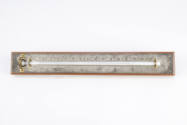
Six's maximum minimum thermometer
Date1910-1930
Inventory Number1998-1-1410
ClassificationThermometer
Subject
Maker
Taylor Instrument Companies
1851 - 1992
Supplier
Andrew J. Lloyd Company
fl. 1890 - 1930
Cultural Region
Place of Origin
Dimensions22.8 x 4.5 x 5.5 cm (9 x 1 3/4 x 2 3/16 in.)
Material
DescriptionA thermometer consisting of a very long tube that makes several turns presenting two long vertical segments each with its own graded scale printed in gold numbers on the case that holds the thermometer.
The vertical segment to the left is labelled "COLD" and has a scale between -130 and 60 degrees (unknown units, most likely Fahrenheit), is partially filled with mercury at the bottom, and also has a thin metal pin inside its capillary. This scale is probably inverted.
The vertical segment to the right is labelled "HEAT" with a scale between -50 and 140 and is partially filled with mercury at the bottom.
There are reservoirs inside the tube at both of its ends. At the leftmost end, after a bend at the top of the "COLD" segment, is an empty stretch of tube. At the rightmost end and directly above the "HEAT" segment, is a bulb filled with a yellowish liquid, probably alcohol.
The thermometer is attached to a black enamel case with a small roof at its top and a hoop for hanging it.
The vertical segment to the left is labelled "COLD" and has a scale between -130 and 60 degrees (unknown units, most likely Fahrenheit), is partially filled with mercury at the bottom, and also has a thin metal pin inside its capillary. This scale is probably inverted.
The vertical segment to the right is labelled "HEAT" with a scale between -50 and 140 and is partially filled with mercury at the bottom.
There are reservoirs inside the tube at both of its ends. At the leftmost end, after a bend at the top of the "COLD" segment, is an empty stretch of tube. At the rightmost end and directly above the "HEAT" segment, is a bulb filled with a yellowish liquid, probably alcohol.
The thermometer is attached to a black enamel case with a small roof at its top and a hoop for hanging it.
Signedtop of plate: ANDREW J LLOYD CO. BOSTON
between the two vertical segments: Ty/cos
Curatorial RemarksStored with 5601.
FunctionThis is a thermometer that combines the function of a maximum and a minimum thermometer, displaying the lowest (left) and highest (right) temperatures to which it has been exposed.
It contains an amount of mercury at the bottom of the U-tube and scales on both sides (the leftmost one inverted) such that at all times the level of mercury in both segments will indicate the same reading. The liquid (probably alcohol) in the rightmost bulb expands and contracts with temperature, pushing the mercury at the bottom to display the right temperature on both ends.
Directly above the mercury on both segments would be a small metal pin (currently only leftmost one visible) that can be moved upwards by the mercury, but does not slide down when the mercury recedes. This way, over a period of time the pins will display the lowest and highest temperatures to which the thermometer has been exposed.
It apparently contains some mercury on its leftmost bulb, but in working order the mercury would be all at the bottom segment of the U-tube.
For resetting it, the pins on both sides would be moved as low as possible, either by shaking, or with magnets if made of the right material.
It contains an amount of mercury at the bottom of the U-tube and scales on both sides (the leftmost one inverted) such that at all times the level of mercury in both segments will indicate the same reading. The liquid (probably alcohol) in the rightmost bulb expands and contracts with temperature, pushing the mercury at the bottom to display the right temperature on both ends.
Directly above the mercury on both segments would be a small metal pin (currently only leftmost one visible) that can be moved upwards by the mercury, but does not slide down when the mercury recedes. This way, over a period of time the pins will display the lowest and highest temperatures to which the thermometer has been exposed.
It apparently contains some mercury on its leftmost bulb, but in working order the mercury would be all at the bottom segment of the U-tube.
For resetting it, the pins on both sides would be moved as low as possible, either by shaking, or with magnets if made of the right material.

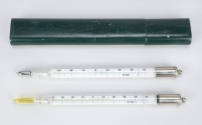
Rudolf Fuess
Date: circa 1858
Accessories: metal case
Object number: DW0789

Taylor Instrument Companies
Date: circa 1920
Object number: DW0633

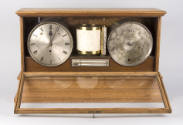
Davis & Son
Date: 1843-1873
Accessories: small metal key
Object number: 1998-1-0606

Henry J. Green
Date: 1890-1910
Accessories: cardboard box
Object number: 1998-1-1271b

R. G. Greiner
Date: circa 1850
Accessories: black cylindrical cardboard case
Object number: DW0792

Edward Marmaduke Clarke
Date: 1838-1840
Accessories: 5 objectives for simple microscope; 2 objectives for compound microscope (1 in can; 1 with lieberkuhn); cup diaphragm with lieberkuhn in brass box; brass box of cover slips; stage forceps; tweezers; 2 live boxes; frog plate; bull's eye; fish tube wire; wrench; chamois; 2 unmounted lenses; 40 prepared slides; standing case; 2 keys.
Object number: 1018

Todd Scientific Company
Date: 1955-1965
Object number: 1996-1-0396