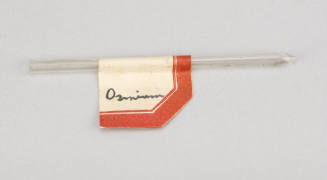
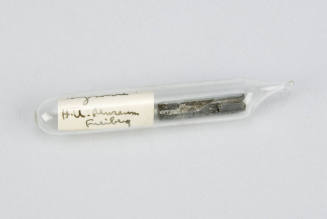
conical crystal solid in cardboard box
Datedated 1946
Inventory Number1998-1-1304
ClassificationCrystal
Subject
Maker
Percy Williams Bridgman
1882 - 1961
Maker(Box)
AKATOS Inc.
1879 - 1944
User
Jefferson Physical Laboratory, Harvard University
founded 1884
Cultural Region
Place of Use
Dimensions2.1 x 6.7 x 4.2 cm (13/16 x 2 5/8 x 1 5/8 in.)
Material
Accessorieswhite cardboard box
wooden shipping crate
DescriptionCardboard box containing a single red crystal cone wrapped in cotton wadding.
Sample was found in a rectangular wooden shipping box with interlocking faces and a removable lid.
Sample was found in a rectangular wooden shipping box with interlocking faces and a removable lid.
Signedtypewritten in blue and black on off-white label on lid of shipping crate in which object was found: AKATOS, Inc. / SCIENTIFIC INSTRUMENTS AND LABORATORY CHEMICALS / 114-118 LIBERTY STREET NEW YORK, N.Y. / Special Handling / To__Jefferson Physical Laboratory__ / Address__Harvard University__ / __Att. Prof. Bridgeman__ Cambridge, Mass.__ / No.___ Value___
Inscribedhandwritten in black on front of shipping crate: Early Resistance
circular black ink stamped on top of shipping crate: NEW YORK N.Y. / MAY 20 / 7 PM / VARICK ST. STA / 1990
handwritten in pencil on lid of shipping crate: 16 / 137x216
handwritten in black on lid ob white cardboard box: KRS-5 Cone / Crystal Section / Do not bother with / this. / NRL / July, 1946
Curatorial RemarksSimilar to 1998-1-1307.
This object was found in a wooden shipping crate from AKATOS Inc. However it is unknown how many of the objects contained in the crate were originally from AKATOS Inc. The crate, labeled "Early Resistance" was most likely used by Prof. Bridgman as a storage container for samples and devices used in his early experiments on the effects of high pressures on the resistance of materials.
FunctionHigh pressure physics.
This sample was likely used in or produced by Prof. Bridgman's early experiments with high pressure apparatuses. It may have been used in experiments testing the high pressure resistance of substances given that the wooden shipping crate in which it was found is labeled "Early Resistance".The crystal may not have been used since "Do not bother with this" is written on the storage box.
This sample was likely used in or produced by Prof. Bridgman's early experiments with high pressure apparatuses. It may have been used in experiments testing the high pressure resistance of substances given that the wooden shipping crate in which it was found is labeled "Early Resistance".The crystal may not have been used since "Do not bother with this" is written on the storage box.
ProvenanceFrom Jefferson Physical Laboratory, Harvard University.
Historical AttributesPercy Bridgman's experimental work at Harvard University consisted mainly in the production of very high pressures and the investigation of the effects such pressures have on the properties of matter.
During the 1920s, most of Bridgman's experiments used high pressures between 12 000 and 20 000 atmospheres (12,000-20,000 kg/cm²). In order to produce such high pressures, Bridgman used a hydraulic press in conjunction with two pumps in order to produce the high pressures. See for example, 1997-1-1819a, b, c and d.
During the 1930s, Bridgman increased the pressure, reaching between 30 000 and 50 000 atmospheres using two and even three hand pumps.
Bridgman would put samples of various materials into a chamber of the press, raise the pressure inside the chamber, and then study the material samples or residues that remained afterward. He the effects of high pressures on the <i>specific resistance, temperature coefficients, volume, electrical conductivity, shearing strength, electrical resistance, density, tensile properties,</i> and <i>compression</i>. He studied these effects on all manner of substances from minerals, metals, and chemicals to plastics, glass and egg yolks. Bridgman hoped his experimental results would contribute to theories of the internal structure of atoms and molecules that were gaining attention throughout the first half of the 20th century. He was awarded the Nobel Prize for Physics in 1946 for his research.
Bridgman also did work on the synthesis of diamonds from graphite using very high pressures and temperatures. Early in 1941, the General Electric Company arranged a five year agreement with Bridgman to finance his experimental research in producing diamonds. Bridgman wanted to reverse a known process in which diamonds turn to graphite at atmospheric pressure and 1500°C. His experiments were conducted in the Harvard Geophysical Laboratory. However, Bridgman was ultimately unsuccessful in the synthesis of diamonds, and his continued research was interrupted by the outbreak of the Second World War.

Percy Williams Bridgman
Date: dated 1946
Accessories: white cardboard box
wooden shipping crate
Object number: 1998-1-1307

Percy Williams Bridgman
Date: 1946
Accessories: small white cardboard box
glass jar
wooden shipping crate
Object number: 1998-1-1308

Percy Williams Bridgman
Date: dated 1916
Accessories: white cardboard box
wooden shipping crate
Object number: 1998-1-1299

Percy Williams Bridgman
Date: dated 1931
Accessories: wooden shipping crate
Object number: 1998-1-1340

Percy Williams Bridgman
Date: circa 1925
Accessories: wooden shipping crate
Object number: 1998-1-1311

Percy Williams Bridgman
Date: circa 1925
Accessories: wooden shipping crate
Object number: 1998-1-1312

Percy Williams Bridgman
Date: dated 1946
Accessories: wooden shipping crate
Object number: 1998-1-1301

Percy Williams Bridgman
Date: circa 1915
Accessories: white cardboard box
wooden shipping crate
Object number: 1998-1-1305

Percy Williams Bridgman
Date: circa 1925
Accessories: wooden shipping crate
Object number: 1998-1-1342

Percy Williams Bridgman
Date: dated 1932
Accessories: wooden shipping crate
Object number: 1998-1-1343

Percy Williams Bridgman
Date: circa 1930
Accessories: wooden shipping crate
Object number: 1998-1-1341a

Percy Williams Bridgman
Date: circa 1925
Accessories: wooden shipping crate
Object number: 1998-1-1341b