


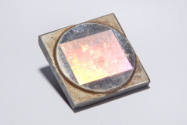
Rowland concave diffraction grating in stand
Date1897
Inventory Number2037
ClassificationDiffraction Grating
Subject
Maker
Henry A. Rowland
1848 - 1901
Maker
John A. Brashear
1840 - 1920
User
Department of Physics, Harvard University
founded 1884
User
Department of Engineering Sciences, Harvard University
founded circa 1918
Cultural Region
Place of Origin
Dimensions18.8 × 11.5 × 7.5 cm (7 3/8 × 4 1/2 × 2 15/16 in.)
Material
DescriptionThe diffraction grating, made of solid speculum metal, is divided with 14,438 lines per inch. The radius of curvature is approximately 183 cm. It is mounted in a wooden stand painted black. The grating can be coarsly adjusted. The letter "H" (meaning Harvard College) has been painted in orange at the back of the plate.
Signedon front: Plate prepared at the Astronomical and / Physical Instrument works of / John Brashear Allegheny Pa / 14438 lines to 1'in 568 to 1 mm
on front: Ruled on Rowland's Engine / Johns Hopkins University / Baltimore Maryland / R = 6ft ± 1897
FunctionA diffraction grating is a glass or mirror that has regularly spaced microscopic interruptions to the passage of light (lines) such that light passing through or reflected by it experiences interference phenomena, magnifying its magnitude at some angles and cancelling it at others. As this effect depends on the wavelength of light, a diffraction grating is an effective method of decomposing light into its constituent wavelengths, that will be transmitted at different angles (short wavelengths -- bluer -- are deflected less than longer -- redder -- ones). If one knows the line density (lines per inch) and the angle of deflection (with a spectrometer), one can deduce the exact wavelengths.
Diffraction gratings like this one were often used in astronomy to produce spectra of celestial objects. Begun in 1882, Rowland's gratings were more than an order of magnitude larger and more accurate than any previous one. With these, for instance, it became possible to measure the wavelength of light emitted by atoms to unprecedented accuracy. Rowland himself was able to draw a new and more accurate map of the solar spectrum.
For more information go to the following website.
Diffraction gratings like this one were often used in astronomy to produce spectra of celestial objects. Begun in 1882, Rowland's gratings were more than an order of magnitude larger and more accurate than any previous one. With these, for instance, it became possible to measure the wavelength of light emitted by atoms to unprecedented accuracy. Rowland himself was able to draw a new and more accurate map of the solar spectrum.
For more information go to the following website.
ProvenanceDepartment of Physics, Harvard University, circa 1897; used for teaching optics Harvard College students in the early 20th century; found in Optics Section of Physics Department, then in the Department of Engineering's Pierce Hall, Harvard University.; transferred to CHSI, 1961.

Henry A. Rowland
Date: circa 1884
Accessories: wooden box; key
Object number: 2031



Robert W. Wood
Date: 1932
Accessories: wooden case
Object number: 2024