Gray Herbarium

Artist Info
Gray Herbariumfounded 1842

The Gray Herbarium had its origins in the personal collections of Asa Gray (1810-1888), who is known as the "Father of American Botany" and a supporter of Charles Darwin. In 1842, Gray was called to Harvard as the new Fisher Professor of Natural History and head of the Botanic Garden founded by William Peck in 1807. At the time, Harvard had no herbarium or botanical library, just a small greenhouse and garden. So, Gray used whatever cash he could spare from his salary to build a library and herbarium, which soon took over his house.

In 1864 Gray offered his collections to Harvard with the stipulation that they build a suitable building to house them. That same year a small brick building was built, and the collections were moved. It is estimated that there were about 200,000 specimens in Gray's herbarium and approximately 2,200 books and pamphlets in his library at the time.

By the time that Gray retired from teaching in 1873, his herbarium had become the principal center for botanical research in the United States.

Today there are about 1,939,914 specimens in the Herbarium. Worldwide in scope, the Gray Herbarium is especially strong in representation for all of North America, including Mexico and the West Indies. The collection contains holotypes, syntypes, Asa Gray photo and isotypes of species described by staff members such as Gray, Watson, Fernald, Johnston, Robinson, Smith, Weatherby, Rollins, and Tryon. Exchange between Gray and J. D. Hooker, the De Candolles and others resulted in the deposition in the Gray Herbarium of isotypes or syntypes of taxa from around the world described by Gray's European contemporaries.

Many early or important individual collections were also deposited in the Gray Herbarium. In recent years the New World representation in the Herbaria has grown through staff collections and through exchange.

Read MoreRead Less
Sort:
Filters
66 results
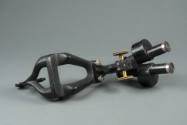
adjustable table on saddle foot for photomicrography
Carl Zeiss Jena
Date: circa 1915
Accessories: ocular with micro-planar lens
Object number: 1996-1-0670
AO cycloptic stereoscopic compound microscope
American Optical Company
Date: circa 1958
Accessories: dual 10x wide field oculars
Object number: 1999-1-0074
American Optical Company
Date: circa 1958
Accessories: dual 10x widefield oculars; microscope lamp; transformer
Object number: 1999-1-0073
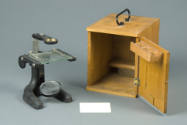
B&L BC continental compound microscope
Bausch & Lomb Optical Company
Date: 1897-1908
Accessories: ocular: 2; objectives (6): B. & L. 1/12, 1/2, 2, Reichert No. 3 and No 7a (missing), Spencer & Smith 1/4, 1; immersion oil in canister; blue filter; square cover glasses; dark-field stop; empty pillbox for cover slips; 5 Triple Alliance glass slides in paper; magnification table; case; key.
Object number: 1387
B&L KC Greenough-type stereoscopic compound microscope
Bausch & Lomb Optical Company
Date: 1915-1924
Object number: 1392
B&L model 31-33-27 adjustable microscope lamp
Bausch & Lomb Optical Company
Date: 1955-1965
Accessories: neutral density filter: 0.1; blue filter
Object number: 1997-1-1892
B&L model 31-33-53 microscope lamp
Bausch & Lomb Optical Company
Date: circa 1960
Accessories: spare bulb No. 1460X in box [1999-1-0079b]
Object number: 1999-1-0079a
B&L research microscope incandescant lamp
Bausch & Lomb Optical Company
Date: circa 1948
Object number: 1997-1-1891
B&L W dissecting simple microscope
Bausch & Lomb Optical Company
Date: circa 1929
Accessories: case
Object number: 1996-1-0130
B&L Y dissecting simple microscope
Triple Alliance: Zeiss - Bausch & Lomb - Saegmuller
Date: 1908-1915
Accessories: coddington magnifiers (2): 38mm, 19mm; handrests (2); wooden case
Object number: 1997-1-1880
B&L Y dissecting simple microscope
Triple Alliance: Zeiss - Bausch & Lomb - Saegmuller
Date: 1908-1915
Accessories: 19mm B & L Coddington magnifier; 7x B & L Coddington magnifier; handrests (2); case
Object number: 1999-1-0078
bracket on saddle foot for photomicrography
Carl Zeiss Jena
Date: 1914
Object number: 1996-1-0652e