


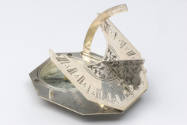
inclining cube sundial
Date1777-1800
Inventory Number7886
ClassificationSundial
Subject
Maker
David Beringer
1756 - 1821
Cultural Region
Place of Origin
Dimensions16.6 x 10 x 8 cm (6 9/16 x 3 15/16 x 3 1/8 in.)
Material
DescriptionThe inclining polyhedral dial is shaped as a cube. The cube is made of a wood block attached to wooden hinge on a pedestal that is mounted on a rectangular platform. The platform has four feet.
The top and sides of the cube are covered in hand-colored, printed paper with decorations and dial furniture. There are 5 brass gnomons, one for each sundial. All gnomons are set for latitude 50°, but by inclining the cube, the user can make the instrument work at other latitudes. The sundials include:
___an inclining horizontal sundial with hours marked IIII-XII-VIII, by 1/4 hours. Decorations include wreaths of flowers and garlands.
___an inclining, direct south, vertical sundial, marked VI-XII-VII by 1/4 hours, and labeled "SUD." Decorations include wreaths of flowers and garlands.
___an inclining, direct north, vertical sundial, marked IIII-VIII and IIII-VIII by 1/4 hours, and labeled "NORD." Decorations include wreaths of flowers and garlands.
___an inclining, direct east, vertical sundial, marked IIII-XI by 1/4 hours. Decorations include the image of a young gentleman and lady holding a ribbon marked with degrees 10°-80°, every 1°. This is for use with a plumb line to set the dial for the correct latitude. The plumb line and brass bob are present. There is another degree scale, running 20°-80°, every 1°, along the lower edge of this face of the cube.
___an inclining, direct west, vertical sundial, marked I-VIII, by 1/4 hours. Decorations include a young gentleman and lady holding a garland of flowers.
The base of the dial consists of the rectangular block of wood sitting on four feet. A magnetic compass is set into the wood. The wind rose is printed on paper and has 8 points labeled with German names and initials. There is a magnetic declination scale of 0°-40°, divided every 2°. An arrow for declination is set at 22°W. The rose is hand-colored green and rose.
The rest of the base is covered on top with hand-colored paper ornamented with a cornucopia of flowers, garlands. On the underside of the base, there is a brass wire, and the numeral "3" in crayon.
The top and sides of the cube are covered in hand-colored, printed paper with decorations and dial furniture. There are 5 brass gnomons, one for each sundial. All gnomons are set for latitude 50°, but by inclining the cube, the user can make the instrument work at other latitudes. The sundials include:
___an inclining horizontal sundial with hours marked IIII-XII-VIII, by 1/4 hours. Decorations include wreaths of flowers and garlands.
___an inclining, direct south, vertical sundial, marked VI-XII-VII by 1/4 hours, and labeled "SUD." Decorations include wreaths of flowers and garlands.
___an inclining, direct north, vertical sundial, marked IIII-VIII and IIII-VIII by 1/4 hours, and labeled "NORD." Decorations include wreaths of flowers and garlands.
___an inclining, direct east, vertical sundial, marked IIII-XI by 1/4 hours. Decorations include the image of a young gentleman and lady holding a ribbon marked with degrees 10°-80°, every 1°. This is for use with a plumb line to set the dial for the correct latitude. The plumb line and brass bob are present. There is another degree scale, running 20°-80°, every 1°, along the lower edge of this face of the cube.
___an inclining, direct west, vertical sundial, marked I-VIII, by 1/4 hours. Decorations include a young gentleman and lady holding a garland of flowers.
The base of the dial consists of the rectangular block of wood sitting on four feet. A magnetic compass is set into the wood. The wind rose is printed on paper and has 8 points labeled with German names and initials. There is a magnetic declination scale of 0°-40°, divided every 2°. An arrow for declination is set at 22°W. The rose is hand-colored green and rose.
The rest of the base is covered on top with hand-colored paper ornamented with a cornucopia of flowers, garlands. On the underside of the base, there is a brass wire, and the numeral "3" in crayon.
In Collection(s)
Signedon north dial face: D. Beringer
Curatorial RemarksA.J. Turner lists Beringer as 1756-1821 in Time, p159.
FunctionThe cube sundial was a special form of polyhedral sundial. The time is found simultaneously on each face of the cube using different projections of the sun's motion. This inclining example is universal, meaning that it can be used at different latitudes.
ProvenanceHarold Clarence Ernst, MD, Boston, c. 1900-1922 (no. 85); Mrs. Ellen L. Ernst (his widow), Jamaica Plain, MA, 1922; on loan to the Museum of Fine Arts, Boston, 1923-1938; gift to Harvard College Observatory, 1938; transfer to CHSI, 1964.



German
Date: early 19th Century
Accessories: None
Object number: 7426


N. James
Date: 1700-1725
Accessories: winding key
Object number: 7935

