


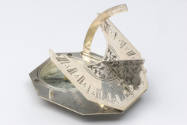


inclining sundial
Date1695-1736
Inventory Number7356
ClassificationSundial
Subject
Maker
Jean-Baptiste-Nicolas Delure
fl. 1695 - 1736
Cultural Region
Place of Origin
DimensionsOverall: 0.6 lb., 5.9 x 1.3 x 7.1 cm (0.3 kg, 2 5/16 x 1/2 x 2 13/16 in.)
Overall - Storage: 2.3 x 7.3 x 7.8 cm (7/8 x 2 7/8 x 3 1/16 in.)
Overall - Storage: 2.3 x 7.3 x 7.8 cm (7/8 x 2 7/8 x 3 1/16 in.)
Material
Accessoriescase
DescriptionThis silver inclining, horizontal sundial is pocket-sized and has its original case.
The horizontal sundial is inscribed on a silver plate that is hinged to another silver plate below. The top plate is cut away to reveal the magnetic compass set into the base plate. Hours are marked IIII-XII-VIII, by 1/4 hours. The folding gnomon is set for a latitude of 60°. The hour plate can be inclined, however, so that users make find the time with this sundial at different latitudes. There is a folding latitude arm against which the hour plates inclination is measured. It is divided 0°-60° by 1° increments.
The magnetic compass in the base has a wind rose of 8 points marked with French names and initials. The needle is blued with a gold "N" and "S" painted on the points.
There is a gazetteer of 43 cities engraved on the top and underside of the base, the underside of the inclined hour plate, and the reverse side of the latitude arm. Some latitudes are given not only in degrees but also in minutes. The choice of cities extends beyond the usual European ones to include Beijing, Isfahan, and Aleppo, among others.
The gnomon, the hour plate, and the springs for the gnomon and latitude arm are ornamented with engravings of acanthus leaves.
The original case is made of wood covered in sharkskin. The hinges and hardware are silver. It is lined in velvet that has faded from rose to tan. There are silver nailhead decorations on the case.
The horizontal sundial is inscribed on a silver plate that is hinged to another silver plate below. The top plate is cut away to reveal the magnetic compass set into the base plate. Hours are marked IIII-XII-VIII, by 1/4 hours. The folding gnomon is set for a latitude of 60°. The hour plate can be inclined, however, so that users make find the time with this sundial at different latitudes. There is a folding latitude arm against which the hour plates inclination is measured. It is divided 0°-60° by 1° increments.
The magnetic compass in the base has a wind rose of 8 points marked with French names and initials. The needle is blued with a gold "N" and "S" painted on the points.
There is a gazetteer of 43 cities engraved on the top and underside of the base, the underside of the inclined hour plate, and the reverse side of the latitude arm. Some latitudes are given not only in degrees but also in minutes. The choice of cities extends beyond the usual European ones to include Beijing, Isfahan, and Aleppo, among others.
The gnomon, the hour plate, and the springs for the gnomon and latitude arm are ornamented with engravings of acanthus leaves.
The original case is made of wood covered in sharkskin. The hinges and hardware are silver. It is lined in velvet that has faded from rose to tan. There are silver nailhead decorations on the case.
In Collection(s)
Signedon underside of hour plate: Delure AParis
FunctionAn inclining dial is similar to a horizontal dial, but its hour plate can be adjusted for use at different latitudes by means of tipping it.
ProvenanceDavid Wheatland purchased from F. & G. Staack, Camden, Maine, June 20, 1959. Donated to CHSI, 1985.


Jacques le Maire
Date: 1738
Accessories: case; plumb bob
Object number: 7416
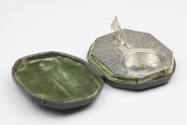
Michael Butterfield
Date: 1684-1687
Accessories: case
Object number: 7472


Johann Martin
Date: 1670-1720
Accessories: case
Object number: 7071

Jean-Louis-Jacques Baradelle
Date: circa 1775
Accessories: case
Object number: 7051


Ludovicus Theodatus Müller
Date: 1750-1770
Accessories: case
Object number: 7079

Michael Butterfield
Date: 1680-1681
Accessories: case
Object number: 7011