


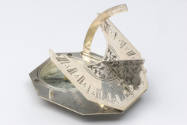
Augsburg-type sundial with case
Datecirca 1700
Inventory Number7052
ClassificationSundial
Subject
Maker
Nicolas Bion
1656 - 1733
Cultural Region
Place of Origin
Dimensions0.6 × 6.7 × 6.2 cm (1/4 × 2 5/8 × 2 7/16 in.)
Material
Accessoriescase
DescriptionThis octagonal, silver sundial rests on the bottom of its compass box. The dial plate is engraved with a gazetteer of 13 European cities and their latitudes.
The compass is shallow and is divided into sixteen sections. There is an eight-point wind rose engraved in the center, with a fleur-de-lis at the tip of the northernmost point. Each arm of the rose is engraved with the French names for the respective cardinal and ordinal directions. There is a brass pointer at 21° west for magnetic declination. The compass is further divided around the perimeter in 2° increments.
The equatorial ring has a continuous hour scale engraved on the top surface. The hour scale is marked with roman numerals I-XII, I-XII, subdivided into quarter-hour intervals, with an arrow every half hour. The sundial's gnomon is a pin mounted to the center of a rotating, bowed bar that bridges the 6 o'clock hours.
The Latitude arm has “Quart de hauteur” engraved on the outer-facing side in French. The opposite side is engraved with the latitudes from 0° to 78°, marked every 5° and further divided into 1° increments.
The underside of the dial plate is engraved with the maker’s name and city. There is also a gazetteer of 25 global cities and their latitudes on the underside of the plate and compass box. Most notably, the names and latitudes of Canada and Lima. Including those listed on the top of the dial plate, this sundial lists 38 cities in total.
This sundial has a leather-covered fitted case with silver pin decoration and velvet lining.
The compass is shallow and is divided into sixteen sections. There is an eight-point wind rose engraved in the center, with a fleur-de-lis at the tip of the northernmost point. Each arm of the rose is engraved with the French names for the respective cardinal and ordinal directions. There is a brass pointer at 21° west for magnetic declination. The compass is further divided around the perimeter in 2° increments.
The equatorial ring has a continuous hour scale engraved on the top surface. The hour scale is marked with roman numerals I-XII, I-XII, subdivided into quarter-hour intervals, with an arrow every half hour. The sundial's gnomon is a pin mounted to the center of a rotating, bowed bar that bridges the 6 o'clock hours.
The Latitude arm has “Quart de hauteur” engraved on the outer-facing side in French. The opposite side is engraved with the latitudes from 0° to 78°, marked every 5° and further divided into 1° increments.
The underside of the dial plate is engraved with the maker’s name and city. There is also a gazetteer of 25 global cities and their latitudes on the underside of the plate and compass box. Most notably, the names and latitudes of Canada and Lima. Including those listed on the top of the dial plate, this sundial lists 38 cities in total.
This sundial has a leather-covered fitted case with silver pin decoration and velvet lining.
Signedon underside of skirt: N. Bion AParis
Curatorial RemarksAppraisal by Brieux, 9/24/84: $3500.
FunctionThis type of sundial, simple to use and adjustable for any latitude, became one of the most popular portable dials during the eighteenth century, particularly in Germany.
ProvenanceDavid Wheatland purchased from Timothy Trace, Peekskill, New York, May 20, 1960. Donated to CHSI 1985.
Historical AttributesNicolas Bion (1681-1733) from Augarde


Jean-Louis-Jacques Baradelle
Date: circa 1775
Accessories: case
Object number: 7051


Ludovicus Theodatus Müller
Date: circa 1760
Accessories: case
Object number: 7077


