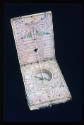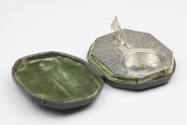

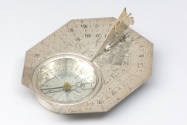


Butterfield-type sundial with case
Date1684-1687
Inventory Number7472
ClassificationSundial
Subject
Maker
Michael Butterfield
1635 - 1724
Cultural Region
Place of Origin
Dimensionsdial closed: 1.6 x 7.8 x 6.6 cm (5/8 x 3 1/16 x 2 5/8 in.)
Material
Accessoriescase
DescriptionThis Butterfield-type sundial is made in the typical "Premier Cadran" form in silver. The octagonal base rests on a compass box and single foot. The hinged gnomon has a little bird whose beak points to the latitude on a scale on the gnomon's edge, running 40°-60° and divided every 1°.
There are four hour scales in concentric "ribbons" on the base. Each is for a different latitude: 43°, 46°, 49°, and 52°. The hours are alternately marked in Roman numerals, IIII-XII-VIII and in Arabic numerals, 4-12-8, all divided into quarter hours. Empty spaces between the sundial furniture are ornamented with engraved acanthus leaves and scrollwork.
The magnetic compass has its original, blued needle. The wind rose has 32 points and is marked with French initials. Magnetic declination is indicated at approximately 15°W.
The underside of the sundial has a gazetteer of 30 European cities with latitudes given in degrees and minutes. The center of the compass box is marked "Premier Cadran." The spring for the gnomon hinge is engraved with acanthus leaves. A tiny hallmark is punched in the upper right corner of the underside. It is a fleur-de-lys within a diamond shape. According to Tardy, p. 124, this is a tax mark of Paris, 1684-1687.
The original traveling case consists of black sharkskin on wood. It is lined with green velvet. The hinge and button clasp are silver.
There are four hour scales in concentric "ribbons" on the base. Each is for a different latitude: 43°, 46°, 49°, and 52°. The hours are alternately marked in Roman numerals, IIII-XII-VIII and in Arabic numerals, 4-12-8, all divided into quarter hours. Empty spaces between the sundial furniture are ornamented with engraved acanthus leaves and scrollwork.
The magnetic compass has its original, blued needle. The wind rose has 32 points and is marked with French initials. Magnetic declination is indicated at approximately 15°W.
The underside of the sundial has a gazetteer of 30 European cities with latitudes given in degrees and minutes. The center of the compass box is marked "Premier Cadran." The spring for the gnomon hinge is engraved with acanthus leaves. A tiny hallmark is punched in the upper right corner of the underside. It is a fleur-de-lys within a diamond shape. According to Tardy, p. 124, this is a tax mark of Paris, 1684-1687.
The original traveling case consists of black sharkskin on wood. It is lined with green velvet. The hinge and button clasp are silver.
In Collection(s)
SignedButterfield AParis
InscribedPremier Cadran
FunctionMichael Butterfield invented a popular and cute form of universal, horizontal sundial. It had a little bird that was used to adjust the sundial for different latitudes.
ProvenanceHarrold E. Gillingham, Philadelphia, Pennsylvania, purchased from Campbell, Paris, 1925. David P. Wheatland purchased from Gillingham, 1949. Donated to CHSI, c. 1985

Jacques le Maire
Date: 1738
Accessories: case; plumb bob
Object number: 7416
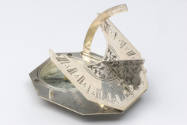


Michael Butterfield
Date: 1680-1681
Accessories: case
Object number: 7011