


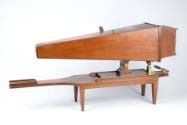


lucernal microscope
Dateca. 1796
Inventory Number0044a
ClassificationMicroscope
Subject
Maker
the Reverend John Prince
1751 - 1836
Cultural Region
Place of Origin
Dimensions46 x 93 x 22.3 cm (18 1/8 x 36 5/8 x 8 3/4 in.)
Material
Accessoriesbox of lenses and slides (0044b)
Bibliography
DescriptionThe microscope consists of a mahogany, pyramidal box in a horizontal position. The box has a hinged top door and an arm to support the door when it is open. The door has a brass plaque inscribed, " Adams' Lucernal / MICROSCOPE / improved by / John Prince."
The objective lens at the narrow end of the pyramidal box is missing. The interior of the box is fitted with a frame to hold the ground glass screen (missing); a frame to hold the reticule (which is a wire screen); and a frame to hold a front screen (missing). The sides are supported by 10 glue blocks. Four of these may be early replacements and are currently unglued.
The box is mounted on a wooden hinge supported by a platform that slides between wooden tracks on a table stand. The table stand has four tapered legs and has projections at both ends. The longer one at the rear end of the box has a pair of wooden tracks to carry a lamp, a condenser, and stage. All are now missing. The shorter projection carries a brass rack-and-pinion focus, which moves the box forward and backward by means of a brass key with a mahogany handle. Fine vertical and horizontal adjustments of the front of the box are accomplished with brass hardware including two knurled screws.
A mahogany sliding door protects the ground glass screen (missing) at the end of the box. A shadow box with a circular opening shades the screen from ambient light in the room.
There is a loose 18th-century paper label marked, "Harvard College / Lucernal microscope."
The objective lens at the narrow end of the pyramidal box is missing. The interior of the box is fitted with a frame to hold the ground glass screen (missing); a frame to hold the reticule (which is a wire screen); and a frame to hold a front screen (missing). The sides are supported by 10 glue blocks. Four of these may be early replacements and are currently unglued.
The box is mounted on a wooden hinge supported by a platform that slides between wooden tracks on a table stand. The table stand has four tapered legs and has projections at both ends. The longer one at the rear end of the box has a pair of wooden tracks to carry a lamp, a condenser, and stage. All are now missing. The shorter projection carries a brass rack-and-pinion focus, which moves the box forward and backward by means of a brass key with a mahogany handle. Fine vertical and horizontal adjustments of the front of the box are accomplished with brass hardware including two knurled screws.
A mahogany sliding door protects the ground glass screen (missing) at the end of the box. A shadow box with a circular opening shades the screen from ambient light in the room.
There is a loose 18th-century paper label marked, "Harvard College / Lucernal microscope."
In Collection(s)
Signedon plaque: John Prince
Inscribedon plaque: Adams' Lucernal / MICROSCOPE / improved by / John Prince
on early paper label: Harvard College / Lucernal microscope
FunctionThe lucernal microscope was a form of projection microscope. The image of the specimen was projected on a ground glass screen, where it could be viewed by multiple people at the same time.
Historical AttributesIn 1792, Harvard College authorized its treasurer to engage John Prince to make a lucernal microscope. Prince received £30 in payment for "a large lucernal microscope and box" and 12 shillings "for alteration in mounting" it in January 1796.
John Prince made notable improvements to the lucernal microscope as invented by George Adams (I), and was given credit for this work by George Adams (II) in the second edition of Essays on the Microscope (1798). Prince's improvements included "a strong joint similar to that of a telescope at about the middle of the center part of the pyramidical box, and a sort of adjusting screw at the large end." Prince also added the shadow box ino order "to secure the image formed upon the rough glass more completely from the light."
Carl Zeiss (Oberkochen)
Date: 1956-1958
Object number: 2015-1-0003


Edward Marmaduke Clarke
Date: 1838-1840
Accessories: 5 objectives for simple microscope; 2 objectives for compound microscope (1 in can; 1 with lieberkuhn); cup diaphragm with lieberkuhn in brass box; brass box of cover slips; stage forceps; tweezers; 2 live boxes; frog plate; bull's eye; fish tube wire; wrench; chamois; 2 unmounted lenses; 40 prepared slides; standing case; 2 keys.
Object number: 1018
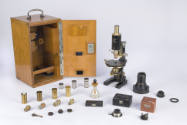
Carl Zeiss, Optische Werkstätte, Jena
Date: circa 1902
Accessories: oculars (5); objectives (5); microplanar objectives (2); iris diaphragm; abbe condenser; collars and sleeves for photography; parts box; Leitz object micrometer (1308b); cardioid condenser (1308d); immersion oil bottle (1308c) ; Leitz erecting prism (1308e); standing case with key
Object number: 1308a


Ernst Leitz (company)
Date: 1898
Accessories: objectives (3): Leitz 3, 7 in original canisters; Spencer Lens Co. 2mm N.A. 1.30 ser. no. 9197; oculars (2): 3, 2; Abbe condenser; holder with 3 cup diaphragms; glass filters (2); box of cover slips; key; standing case
Object number: 1994-1-0007a

Thomas de Colmar
Date: circa 1860
Accessories: two instruction books (in French) dated 1856, 1860; explanatory article by F. Reuleaux (in German) dated 1892
Object number: 1990-5-0026

Carl Zeiss Jena
Date: circa 1928
Accessories: standing case; key
Object number: 2000-1-0038

Carl Zeiss Jena
Date: circa 1910
Accessories: ocular: K 20x ; objectives (3): Zeiss 2 mm HI, Zeiss 40 apochromat, B&L 10x apochromat; Abbe condenser; iris diaphragm; standing case
Object number: 1365


the Reverend John Prince
Date: ca. 1796
Accessories: One "substage" mirror; 1 condensing lens in blackened mount; 2 magnifiers or condensers in brass mounts; 1 cone diaphragm; 3 sliders; 7 objectives; flat case.
Object number: 0044b

Carl Zeiss, Optische Werkstätte, Jena
Date: circa 1898
Accessories: oculars (4): 2, 4, and compensating oculars 6, 8; objectives: AA, DD, a2, and apochromat HI 2.0 mm; triple nosepiece; swing-out condenser with iris-cylinder diaphragm; disk diaphragm and central stop diaphragm; filter; eyepiece micrometer, brush, spare stage clips; large mechanical stage (2006-1-0114b); centering glass (2006-1-0114c) with instructions; magnification tables (2); standing case; key; leather traveling case (2006-1-0114d).
Object number: 2006-1-0114a
See also/See also
