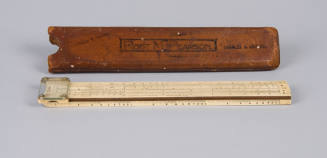
Polyphase slide rule
Datepatented 1933
Inventory Number1997-1-1925
ClassificationSlide Rule
Subject
Maker
Keuffel & Esser Company
1867 - 1987
Cultural Region
Place of Origin
Dimensionsslide rule: 4.1 × 52.2 × 1.6 cm (1 5/8 × 20 9/16 × 5/8 in.)
leather case: 5.6 × 53.1 × 3.3 cm (2 3/16 × 20 7/8 × 1 5/16 in.)
leather case: 5.6 × 53.1 × 3.3 cm (2 3/16 × 20 7/8 × 1 5/16 in.)
Material
Accessoriesblack leather case with flap closure
Bibliography
DescriptionRectangular wooden rule faced with white celluloid. The top and bottom slides are fixed; the center slide is printed on both sides and moves left and right. A glass runner with a vertical line down its center also moves left and right. The runner is in two parts, which are screwed together around the slides.
The fixed portion of the slide rule is printed with three scales. Along the bottom edge of the top slide is an "A" scale consisting of two logarithmic scales (values ranging from 1 to 10) placed side-by-side. Along the top edge of the third slide is a logarithmic "D" scale carrying values from 1 to 10. Printed along the bottom edge of the same (third) slide is a "K" scale consisting of three logarithmic scales (values ranging from 1 to 10) placed side-by-side.
The front of the moveable slide is printed with three scales. The "B" scale along its top edge is identical to the "A" scale on the fixed portion of the rule. The "C" scale along its bottom edge is identical to the "D" scale on the fixed portion of the rule. The center scale, "CI," is an inverted logarithmic scale, with values descending from 10 to 1. This scale is printed in red ink.
The back of the moveable slide is also printed with three scales. Printed along its top edge is an "S" scale, carrying values from 35' to 90°. Along the center of the slide is an "L" scale, with values ranging from 0 to 1. Printed along the bottom edge of the slide is a "T" scale, carrying values from 5.5 to 45.
Five screws are visible on the back of the rule. Printed on an elliptical sheet of white celluloid affixed to the back of the rule is a table of unit conversions. The top edge of the rule is printed with a 20-inch scale. The bottom edge of the rule is printed with a 50-centimeter scale.
The slide rule is stored in a black leather case with flap closure.
The fixed portion of the slide rule is printed with three scales. Along the bottom edge of the top slide is an "A" scale consisting of two logarithmic scales (values ranging from 1 to 10) placed side-by-side. Along the top edge of the third slide is a logarithmic "D" scale carrying values from 1 to 10. Printed along the bottom edge of the same (third) slide is a "K" scale consisting of three logarithmic scales (values ranging from 1 to 10) placed side-by-side.
The front of the moveable slide is printed with three scales. The "B" scale along its top edge is identical to the "A" scale on the fixed portion of the rule. The "C" scale along its bottom edge is identical to the "D" scale on the fixed portion of the rule. The center scale, "CI," is an inverted logarithmic scale, with values descending from 10 to 1. This scale is printed in red ink.
The back of the moveable slide is also printed with three scales. Printed along its top edge is an "S" scale, carrying values from 35' to 90°. Along the center of the slide is an "L" scale, with values ranging from 0 to 1. Printed along the bottom edge of the slide is a "T" scale, carrying values from 5.5 to 45.
Five screws are visible on the back of the rule. Printed on an elliptical sheet of white celluloid affixed to the back of the rule is a table of unit conversions. The top edge of the rule is printed with a 20-inch scale. The bottom edge of the rule is printed with a 50-centimeter scale.
The slide rule is stored in a black leather case with flap closure.
Signedface, top slide, top left: KEUFFEL & ESSER CO. N.Y.;
top edge of runner: KEUFFEL & ESSER CO. N.Y.
Inscribedface, top slide, top center: PAT. 1,934,232;
face, top slide, top right: MADE IN U.S.A.;
face, center slide, right: <N4053-5>;
back, center slide, left: 957041
bottom edge of runner: PATENT 2,086,502
Curatorial RemarksPatent number 1,934,232 was issued to Adolf Keuffel in 1933;
Same series as 1989-1-0012, though has "K" scale on rule face, is of a later date, is longer, and is without trigonometric Poly
FunctionFor solving mathematics problems containing combinations of three factors, as well as problems involving squares, square roots, cubes, cube roots, and higher powers and roots.
For details on using the rule to solve particular problems, see William E. Breckenridge's manual, available for download here.
For details on using the rule to solve particular problems, see William E. Breckenridge's manual, available for download here.
ProvenanceOwned by William R. Osgood (Engineer, Harvard 1917); donated by his nephew, Theodore K. Osgood, on November 20, 1997.

Keuffel & Esser Company
Date: circa 1917
Accessories: Brown leather case with flap closure, for storage.
Object number: 1989-1-0012

Keuffel & Esser Company
Date: patented 1900
Accessories: brown leather case, for storage
Object number: 2003-1-0225


Keuffel & Esser Company
Date: circa 1917
Accessories: rectangular black leather case
Object number: 1997-1-1631


Keuffel & Esser Company
Date: ca. 1915-1923
Accessories: Brown leather case with flap closure, for storage
Object number: 1997-1-2006

Keuffel & Esser Company
Date: copyright 1947
Accessories: brown leather case, with metal-reinforced belt clip
Object number: 1997-1-0971


Keuffel & Esser Company
Date: circa 1935
Accessories: card describing use; brown leather case with metal-reinforced flap closure, for storage
Object number: 1997-1-2005

Keuffel & Esser Company
Date: 1908-1921
Accessories: sliding brown leather case
Object number: 1997-1-0979

Hemmi
Date: 1971
Accessories: brown leather case with glap closure; brown leather loop for attachment to belt
Object number: 1989-1-0009

Eugene Dietzgen Company
Date: early 20th-mid 20th Century
Accessories: brown leather case with flap closure and model information printed in gold
Object number: 2003-1-0223
See also/See also