


Lowry-Bowyer telemeter
Date1896
Inventory Number5331
ClassificationTelemeter
Subject
Maker
Lowry Manufacturing Company
1896 - ca.1900
Cultural Region
Place of Origin
Dimensions6.4 × 70.9 × 15.1 cm (2 1/2 × 27 15/16 × 5 15/16 in.)
Material
DescriptionInstrument consists of a rectangular brass plate attached to the top surface of a stepped wooden platform. Each edge of the brass disc is marked with an 18" engraved rule. Each inch is further subdivided in tenths. There is a track cut through the center of the brass plate, above a corresponding groove carved in the wooden platform, in which two brass discs sit. One of the brass discs is fixed and the other can slide back and forth along the track. Each disc is divided into degrees marked in tens from 0° to 90° to 0° to 90° and to 0°. The 32 compass points are also engraved on an inner circle on the brass discs. Each disc has a pivoting brass arm extending from the center. These arms are divided and marked into 18", each of which is subdivided in 10. The sliding disc has two rectangular windows cut in it through which the scale on the brass faceplate can be seen.
There are two metal nails protruding from the edges of the wooden platform near the fixed brass disc. These may be for mounting the instrument on a vertical surface when in use.
There are two metal nails protruding from the edges of the wooden platform near the fixed brass disc. These may be for mounting the instrument on a vertical surface when in use.
Signedengraved on instrument face: THE LOWRY MFG. CO. / BOSTON, U.S.A. / PATENT, 1887'92.'96.
Curatorial RemarksA similar instrument is owned by the Yale University Natural History Museum. That one includes its original box.
Its catalog entry can be found <a href="http://peabody.research.yale.edu/cgi-bin/Query.Ledger?LE=hsi&ID=irn%20322132&SU=0" target="_blank">here</a>.
See also Saul Moskowitz Catalogue No. 120 (Spring 1980), Item no. 216.
Cleaned by E. Wheatland, varnished by D.R. Gay, March, 1977.
FunctionThis telemeter (unlike those equipped with sights or telescopes) is designed to measure distances without a rule, by measuring relevant angles. The rotating arms would be aligned with the relevant points in space in order to provide angle measurements from which distances can be extrapolated.

Jakob Amsler
Date: circa 1906
Accessories: instrument is in four (4) parts; the rail is in own box and is inventory # 2006-1-0002b; letter from Prof. William Brower containing the complete history of ownership and use (missing)
Object number: 2006-1-0002a
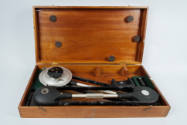
Charles Bruning Company
Date: 1942
Accessories: plywood case; 3/4 inch wrench; black metal end pieces
Object number: 2003-1-0127


Walter Balcke
Date: 1952-1964
Accessories: mahogany case; two circular protractors; clear plexiglass rule with serated edge
Object number: 1990-5-0028
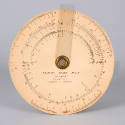

Walter Balcke
Date: 1952-1964
Accessories: mahogany box; cardboard instruction card
Object number: 1997-1-1601


Fabre et Cie
Date: circa 1856
Object number: 5469


H Hughes & Son
Date: ca. 1890-1903
Accessories: 2 plastic (celluloid?) circular discs, pin tool; telescope; leather strap; pencil; 2 erasers; peep sight; eye shade; extra screws
Object number: 5318

G. Coradi
Date: circa 1911
Accessories: conversion table on white card in instrument case; instrument case
Object number: 1999-1-0068