


centigraph
Datecirca 1891
Inventory Number5402
ClassificationCalculating Machine
Subject
Attributed to
American Adding Machine Company
founded c. 1902
Cultural Region
Place of Origin
Dimensions16.4 × 20.7 × 15.4 cm (6 7/16 × 8 1/8 × 6 1/16 in.)
Material
DescriptionThe centigraph is stored in a dark brown box with five sides that sits directly on top of the apparatus' base plate. There is a small metal circular handle attached to the center of the top of the storage box. The bottom of the base plate is matted with felt, but the felt is now peeling off.
The centigraph sits on a flat, rectangular, wooden (walnut) base. The edges of the base are aesthetically tiered. There is a metal plate with scalloped corners fastened to the surface of the wooden base with four screws.
The main calculating mechanism is attached to the metal plate by a black-painted L-shaped support. The short part of the 'L' is parallel to the left edge of the base plate and the long part of the 'L' is parallel to the back edge of the base plate. There is a stand rising from the center of the long part of the 'L', with a pivot at the top.
There are three circular discs with a diameter of about 11.5 cm that rotate with that pivot at their center. The discs are parallel to one another and angled towards the front of the base plate.
The disc closest to the back has eight large holes in it, around the center, and the whole circumference is serrated into small teeth. Only these small teeth are visible to an observer standing in front of the apparatus.
The center disc is thicker than the first. The circumference is numbered incrementally, counter-clockwise from 0 - 99. Inside the circumference of numbers there is a continuous deep groove that makes five circles of decreasing diameter.
The front-most is thinner. The circumference of this disc is divided into twenty equal sections, each marked with a straight edge, tangential to the circumference, leading to a sharp point. The effect of this division is that the disc has large saw-like teeth. The entire surface of this disc is visible from in front of the base machine. On the visible surface of the front most disc, there is a brass arrow attached at the tail by a pivot. The pointed end of the arrow can sit in one of five positions housed on an exposed metal track. The exposed track is the deep spiral groove of five circles on the center disc. If the arrow starts at the outermost point, it will move towards the inner most position along the groove as the disc rotates. Once in the center, the arrow needs to be manually reset to the outside. Below (or above, depending on the position of the disc) the track, the numbers 1 - 5 are engraved in the disc such that each position of the arrow is numbered. The engraved numbers are difficult to see on this model because the disc is quite rusted. There is also a small, rectangular, two-digit numeral display on the surface of the disc. The displayed numbers are those engraved around the circumference of the center disc.
There are two metal levers rising from the short part of the 'L' in the black base. The backmost extension has a small triangular piece that 'hooks in' to the teeth of the backmost disc. The front most extension has a larger triangular piece that 'hooks in' to the teeth of the front most disc. As the discs rotate, these triangular pieces will hook into successive teeth as they pass. The discs are spring loaded and these levers keep them in place.
There are five metal arms that extend in front of and below the discs. Each arm has a button at the end. The buttons are numbered in decreasing unit increments from left to right, from 5 to 1. However, on this model, the leftmost button (5) is missing. Each extension arm is supported by a metal frame attached to the base plate.
A helpful website with pictures of many other centigraph models, including a catalogue article from 1890 with an explanation and image of a centigraph can be accessed here.
The centigraph sits on a flat, rectangular, wooden (walnut) base. The edges of the base are aesthetically tiered. There is a metal plate with scalloped corners fastened to the surface of the wooden base with four screws.
The main calculating mechanism is attached to the metal plate by a black-painted L-shaped support. The short part of the 'L' is parallel to the left edge of the base plate and the long part of the 'L' is parallel to the back edge of the base plate. There is a stand rising from the center of the long part of the 'L', with a pivot at the top.
There are three circular discs with a diameter of about 11.5 cm that rotate with that pivot at their center. The discs are parallel to one another and angled towards the front of the base plate.
The disc closest to the back has eight large holes in it, around the center, and the whole circumference is serrated into small teeth. Only these small teeth are visible to an observer standing in front of the apparatus.
The center disc is thicker than the first. The circumference is numbered incrementally, counter-clockwise from 0 - 99. Inside the circumference of numbers there is a continuous deep groove that makes five circles of decreasing diameter.
The front-most is thinner. The circumference of this disc is divided into twenty equal sections, each marked with a straight edge, tangential to the circumference, leading to a sharp point. The effect of this division is that the disc has large saw-like teeth. The entire surface of this disc is visible from in front of the base machine. On the visible surface of the front most disc, there is a brass arrow attached at the tail by a pivot. The pointed end of the arrow can sit in one of five positions housed on an exposed metal track. The exposed track is the deep spiral groove of five circles on the center disc. If the arrow starts at the outermost point, it will move towards the inner most position along the groove as the disc rotates. Once in the center, the arrow needs to be manually reset to the outside. Below (or above, depending on the position of the disc) the track, the numbers 1 - 5 are engraved in the disc such that each position of the arrow is numbered. The engraved numbers are difficult to see on this model because the disc is quite rusted. There is also a small, rectangular, two-digit numeral display on the surface of the disc. The displayed numbers are those engraved around the circumference of the center disc.
There are two metal levers rising from the short part of the 'L' in the black base. The backmost extension has a small triangular piece that 'hooks in' to the teeth of the backmost disc. The front most extension has a larger triangular piece that 'hooks in' to the teeth of the front most disc. As the discs rotate, these triangular pieces will hook into successive teeth as they pass. The discs are spring loaded and these levers keep them in place.
There are five metal arms that extend in front of and below the discs. Each arm has a button at the end. The buttons are numbered in decreasing unit increments from left to right, from 5 to 1. However, on this model, the leftmost button (5) is missing. Each extension arm is supported by a metal frame attached to the base plate.
A helpful website with pictures of many other centigraph models, including a catalogue article from 1890 with an explanation and image of a centigraph can be accessed here.
Signedunsigned
Inscribedengraved on right side of base plate: THE CENTIGRAPH / PAT / JUNE 9. 91 /
1453.
Curatorial RemarksThe number 5 key pad is missing.
spring is very weak; the machine can't add by fours because the spring won't go that far to the left
the machine is unsigned, but it does indicate that the device was patented in 1891. The American Adding Machine Co. in Atlanta, GA is listed elsewhere as having the patent for the centrigraph in 1891. They are likely the maker of this device.
see <a href="http://www.earlyofficemuseum.com/calculating_machines_adders.htm"_blank">this website</a> for this listing.
FunctionThe centigraph is a mechanical adding machine. Users input the desired numbers using the key pad. For numbers greater than five, two keys can be depressed simultaneously. Every input number is added to the counter. The counter is the visible numeral display on the front most disc. The counter can count up to 99. However, the arrow on the front most disc can point to any number from 1 to 5 and these are the hundreds position. Therefore, the adding machine can count up to 599 at which point the adding machine must be reset by putting the arrow back to its outermost position and resetting the counter.
The following description of the key pad, spring mechanism, and counting of the instrument is taken from the original curatorial cards that accompany the instrument:
"Rods with keys 1 through 4 pass under [a horizontal] shaft [at the base of the discs] curving up-wards from under discs and connecting on left with the two levers holding discs in place. When key is depressed, rod presses shaft upwards, which releases one lever, allowing small-toothed disc to turn. Immediately afterwards, spring coil on right end of shaft expands to left, pushing a little vertical catch before it which catches a tooth and stops the disc. Key rod pushing up from below keeps catch from moving any farther to left. If 3-key is depressed, catch slides 3 spaces to the left until it hits 3 rod and is stopped: that distance equals the distance of three teeth on disc. When 5-key is depressed, it hits directly the lever holding large-toothed disc stationary (it does not - like the other key-rods-pass underneath discs and shaft). Disc is released until it is stopped by catch at other end of lever, 5 spaces around the edge (corresponding to only one of the large tooth-gaps). When 1-key is depressed successively, numbers under window increase by ones; when 2 lever is depressed they advance by twos, and so on through fives."
The following description of the key pad, spring mechanism, and counting of the instrument is taken from the original curatorial cards that accompany the instrument:
"Rods with keys 1 through 4 pass under [a horizontal] shaft [at the base of the discs] curving up-wards from under discs and connecting on left with the two levers holding discs in place. When key is depressed, rod presses shaft upwards, which releases one lever, allowing small-toothed disc to turn. Immediately afterwards, spring coil on right end of shaft expands to left, pushing a little vertical catch before it which catches a tooth and stops the disc. Key rod pushing up from below keeps catch from moving any farther to left. If 3-key is depressed, catch slides 3 spaces to the left until it hits 3 rod and is stopped: that distance equals the distance of three teeth on disc. When 5-key is depressed, it hits directly the lever holding large-toothed disc stationary (it does not - like the other key-rods-pass underneath discs and shaft). Disc is released until it is stopped by catch at other end of lever, 5 spaces around the edge (corresponding to only one of the large tooth-gaps). When 1-key is depressed successively, numbers under window increase by ones; when 2 lever is depressed they advance by twos, and so on through fives."
ProvenanceMallinckrodt Chemical Laboratory, Harvard University; transferred to CHSI November 1, 1948.

Jakob Amsler
Date: circa 1906
Accessories: instrument is in four (4) parts; the rail is in own box and is inventory # 2006-1-0002b; letter from Prof. William Brower containing the complete history of ownership and use (missing)
Object number: 2006-1-0002a
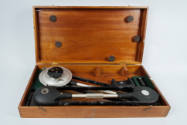
Charles Bruning Company
Date: 1942
Accessories: plywood case; 3/4 inch wrench; black metal end pieces
Object number: 2003-1-0127

Gebrüder Haff
Date: 1960-1969
Accessories: plush-lined, hard green case
white card with instrument information in case
Object number: 1999-1-0005

Adix Company
Date: circa 1905
Accessories: imitation leather covered, velvet and satin lined case
Object number: DW0325

Walter Balcke
Date: 1958
Accessories: mahogany case with plastic top; cardboard instruction card;
in library folder (Lib 4927):
-twenty-one letters from Joseph L. Walsh, mathematics professor at Harvard University, to Walter Balcke, dated between 27 May 1957 and 24 January 1964 (letters thank Balcke for the many mathematical models he gifted to the Mathematics Department, praise his skill and ingenuity, many invite him to faculty and personal luncheons, and one letter provides an analytic solution to the "13-point problem" behind one of Balcke's models)
- one letter from J.L. Walsh pertains directly to this object, dated January 30, 1958
-three letters from Garret Birkhoff (then Chairman of the Harvard Mathematics Department) dated 3 March 1954, 4 January 1955, and 10 January 1955, each expressing gratitude (and in one case, an official department thank you) for the many mathematical models he gifted to the mathematics department
-photocopy of original envelope in which correspondence between mathematics department and Walter Balcke was stored (original was destroyed on 13 July 1997)
-photocopy of instructional card for object 1997-1-1671
- seven instructional cards that accompany the following Balcke models: Pascal's Theorem, Brianchon's Concurrent Lines, Trisector, Twelve Point Ellipse, Rolling Parabola, unknown, Equation Solution with a 'Constant' Variable and Thread
- photograph of the display case containing Balcke's models in the Harvard Mathematics department
Object number: 1990-5-0029

American
Date: circa 1941
Object number: 1998-1-0265
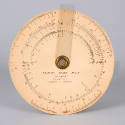
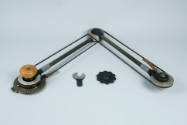
Keuffel & Esser Company
Date: 1954-1969
Accessories: mahogany case; 3/4 inch wrench; extra knobs
Object number: 1997-1-1859


French
Date: circa 1880
Accessories: protecting case with glass window
Object number: DW0095
See also/See also
