Burslow ellipsograph
Datecirca 1873
Inventory Number5120
ClassificationEllipsograph
Subject
Maker
W. F. Stanley & Company, Ltd.
1854 - 1999
Maker
William F. Stanley
1829 - 1909
Cultural Region
Place of Origin
Dimensions12 x 23.5 x 11 cm (4 3/4 x 9 1/4 x 4 5/16 in.)
Material
Accessoriescase
DescriptionThis ellipsograph is made of nickel and is a precision instrument.
Two legs support two long metal bars that form a track along which the main mechanism slides horizontally. The foot of each leg is a long bar with a leveling screw at each end. A bracket is attached to one end of the tracking bars and extends over it. The far end holds the hand crank which rotates a bar below and parallel to it. This bar slides into a fitting on top of one end of the gearing mechanism below. The working length of the bar can be fixed by a locking screw.
At the other end of the main tracking bars, there is a pivot. Two parallel plates are attached to the pivot, and hold between them a stack of gear trains between shorter parallel plates. Each gear train is composed of three gears. At one end, the upper and lower gears share a common pivot. At the far end, the upper gear is attached to the fitting in which the bar slides. The lower gear at this end is attached to a slider in the track. A fitting below the track transfers the motion to a pen or pencil carried on a beam.
The ellipsograph comes with extension arms for this beam and fittings for graphite and ink.
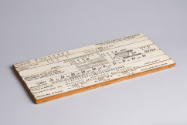
The ellipsograph is stored in a fitted mahogany box padded with green wool felt. A trade card is glued inside the lid.
Two legs support two long metal bars that form a track along which the main mechanism slides horizontally. The foot of each leg is a long bar with a leveling screw at each end. A bracket is attached to one end of the tracking bars and extends over it. The far end holds the hand crank which rotates a bar below and parallel to it. This bar slides into a fitting on top of one end of the gearing mechanism below. The working length of the bar can be fixed by a locking screw.
At the other end of the main tracking bars, there is a pivot. Two parallel plates are attached to the pivot, and hold between them a stack of gear trains between shorter parallel plates. Each gear train is composed of three gears. At one end, the upper and lower gears share a common pivot. At the far end, the upper gear is attached to the fitting in which the bar slides. The lower gear at this end is attached to a slider in the track. A fitting below the track transfers the motion to a pen or pencil carried on a beam.
The ellipsograph comes with extension arms for this beam and fittings for graphite and ink.
The ellipsograph is stored in a fitted mahogany box padded with green wool felt. A trade card is glued inside the lid.
Signedengraved on arm: STANLEY, GREAT TURNSTILE, HOLBORN, LONDON.
on trade card inside lid of case: MADE BY / W. F. STANLEY, / Optical, Philosophical & Mathematical / INSTRUMENT MANUFACTURER, / ENGINE DIVIDER, &c. / MATHEMATICAL DEPARTMENT, GREAT TURNSTILE, HOLBORN, W.C.
Inscribedengraved on arm: BURLOW'S PATENT / No. 9
note of royal appointment on trade card attached inside the lid of the stroage box: To H. M. Government Science & Art Depnt. Council of India, Admirality, &c. / [a Lion and Unicorn seal] /
FunctionThe ellipsograph is used for mechanically drawing ellipses. Turning the crank indirectly imparts the necessary horizontal and rotational motion to the end of the adjustable drawing extension for it to produce ellipses. By varying the lengths of the beams, ellipses of different profiles are drawn.
Historical AttributesThis particular form of ellipsograph (or elliptograph, as its maker, W. F. Stanley, called it) was invented by an architect, Edward Burslow of Horsham, England. Stanley, however, calls him Burstow in his book of 1873 and later editions.

J. Fairbanks
Date: 1870-1900
Accessories: mahogany case with green felt interior
Object number: 1997-1-1858


Forster
Date: 1950-1960
Accessories: spare ink cartridges; pen attachments
am auxiliary box containing small Allen wrench, scotch tape, extra parts, and storage instructions
Object number: 1999-1-0054

Fabre et Cie
Date: circa 1856
Object number: 5470


Jakob Amsler
Date: circa 1906
Accessories: instrument is in four (4) parts; the rail is in own box and is inventory # 2006-1-0002b; letter from Prof. William Brower containing the complete history of ownership and use (missing)
Object number: 2006-1-0002a


Damon Engineering, Inc.
Date: 1962-1972
Object number: 2006-1-0079