



almucantar
Date1884-1910
Inventory Number1997-1-1809
ClassificationAlmucantar
Subject
Maker
Ballou Manufacturing Company
fl. 1880 - 1890
Maker
John Clacey
1857 - 1931
Inventor
Seth Carlo Chandler Jr.
1846 - 1913
User
Harvard College Observatory
founded 1839
User
Students' Astronomical Laboratory, Harvard University
1903 - c. 1953
Cultural Region
Place of Origin
Dimensions97 x 80 x 58 cm (38 3/16 x 31 1/2 x 22 13/16 in.)
Material
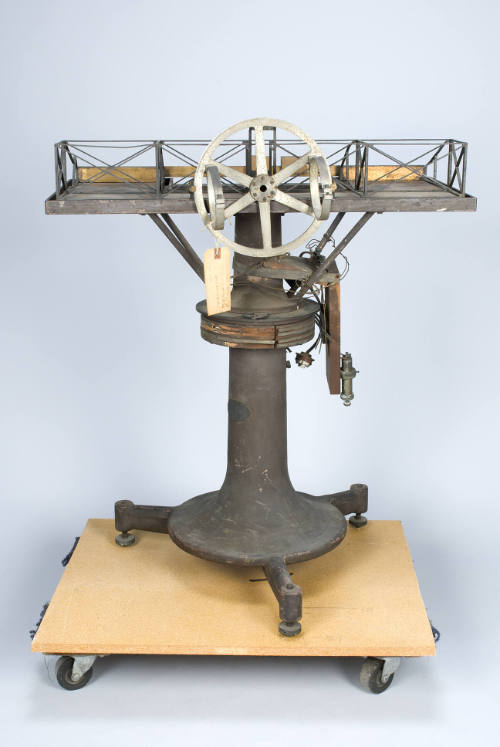
DescriptionA hollow iron pillar ends into a tripod, each foot terminated by a leveling screw. Around the middle of the pillar is what appears to be the original finding-circle of brass and vernier (corroded now). Instead of turning the instrument by hand as in 1884-1885, this modified version of the instrument has an electrical mechanism to make the almucantar turn by the push of a contact-button. A thick circular piece of wood is set on top of the lower part of the pillar and is encircled with four rows of thin metallic bands. They match the similar bands attached on the vertical piece of wood held in place on the upper part of the pillar (one is missing). Four electrical connectors provided electricity to the bands and to one light socket (bulb missing). Though it is now dangling, the latter was set into the round support attached to the above trough. (Originally, Chandler had a patent candle lantern for illumination.)
The trough is supported by four diagonal braces fixed on the sleeve above the finding-circle. It is rectangular in shape and was meant to hold mercury. In one corner there is a small screw-plug for emptying the trough. On top of it rests a float made of two parts: the frame and the floor. The frame is a lattice work made of brass. On one side the telescope (missing) is held in place by two clamps. A graduated circle (4 x 90°) and vernier are used to determine the height of stars. On the opposite side of the telescope are a brass bar and two counterweights. The floor is made of cherry wood, lacquered, and made to float on the mercury. The amount of mercury poured into the trough was circa thirty-three and a half pounds.
The trough is supported by four diagonal braces fixed on the sleeve above the finding-circle. It is rectangular in shape and was meant to hold mercury. In one corner there is a small screw-plug for emptying the trough. On top of it rests a float made of two parts: the frame and the floor. The frame is a lattice work made of brass. On one side the telescope (missing) is held in place by two clamps. A graduated circle (4 x 90°) and vernier are used to determine the height of stars. On the opposite side of the telescope are a brass bar and two counterweights. The floor is made of cherry wood, lacquered, and made to float on the mercury. The amount of mercury poured into the trough was circa thirty-three and a half pounds.
Signedon central pillar, plaque: THE BALLOU MFG. CO. / MAKERS / HARTFORD, CONN.
Curatorial RemarksThe Clacey telescope is no longer with the instrument.
FunctionInstrument to precisely measure the latitude of stars. It was used by Chandler to demonstrate the polar motion, which modify the measured position of stars by a small amount every fourteen months.
Historical AttributesThis is most likely the almucantar that Chandler had had made in 1884, which was later modified with the electrical rotational mechanism now found on this machine. The article says that the Ballou Manufacturing company did the mechanical portion of the instrument while the optical parts were delivered by Mr. John Clacey, of Cambridgeport.
Chandler also mentions in his article that two almost identical instruments were made at the same time: one for him and one for Mr. Charles H. Rockwell, who mounted it in his private observatory in Tarrytown, N.Y. The only difference are that some of the parts on Chandler's instrument were made of aluminum instead of brass for Rockwell's.

Richard W. Thomas
Date: circa 1861
Accessories: bottle and beaker (1998-1-1634a); hydrometer and manual (1998-1-1634b)
Object number: 1998-1-1634

Bausch, Lomb, Saegmuller Company
Date: 1905-1907
Accessories: screwdriver; key; dust cap; sunshade; carrying case; tripod (5162b)
Object number: 5162a


C. F. Casella & Co. Ltd.
Date: circa 1920
Accessories: case
Object number: 1989-1-0028


Breton Frères
Date: circa 1850
Accessories: 6 convertible objectives; 4 nosepieces, one with polarizer; 4 oculars; black / white disk; spare round stage with offset diaphragm; camera lucida; light polarizing insert; compressorium by Chevalier; fish trough; 2 prepared slides; 3 cuvettes; brass box specimen holder with compressed slides and collar to attach to microscope; flat case.
Object number: 1274


