


watchmaker's transit
Datecirca 1880
Inventory Number1997-1-1800
ClassificationTransit
Subject
Maker
John Bliss & Company
1857 - 1956
Owner
William Bond and Son
fl. 1793 - 1977
Owner
W. H. Stedman
fl. 1908
Cultural Region
Place of Origin
Place of Use
Dimensionswith telescope horizontal: 23.6 x 20.1 x 29.5 cm (9 5/16 x 7 15/16 x 11 5/8 in.)
Material
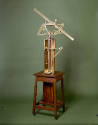
DescriptionA refracting telescope is mounted on two conical arms that are carried in a cradle. The cradle is brass and attached to the mounting struts.
At the end of one of the arms, there is a divided circle. It is graduated 0-90-0-90-0 degrees with northern and souther halves of the circle indicated by initials at the zero points. A knurled thumb screw is in the center of the wheel and permits one to adjust the rotation of the wheel with respect to the orientation of the telescope. A reading mark is on a semicircle of brass attached to the upright strut.
The telescope has a dust cap on the objective. A drawtube for the eyepiece provides focus. The eyepiece has a solar diagonal attached with a wheel of filters. The tube has cross hairs. (The telescope and altitude circle are shiny brass, having been cleaned by Ebenezer Gay in 1980. The reading mark and scale were to be resilvered, but this was never done.)
The mounting is cast. It consists of two, open triangular uprights and a base of two open concentric circles. The base has two pointy feet and one shiny brass leveling screw foot. The castings have been painted yellow.
At the end of one of the arms, there is a divided circle. It is graduated 0-90-0-90-0 degrees with northern and souther halves of the circle indicated by initials at the zero points. A knurled thumb screw is in the center of the wheel and permits one to adjust the rotation of the wheel with respect to the orientation of the telescope. A reading mark is on a semicircle of brass attached to the upright strut.
The telescope has a dust cap on the objective. A drawtube for the eyepiece provides focus. The eyepiece has a solar diagonal attached with a wheel of filters. The tube has cross hairs. (The telescope and altitude circle are shiny brass, having been cleaned by Ebenezer Gay in 1980. The reading mark and scale were to be resilvered, but this was never done.)
The mounting is cast. It consists of two, open triangular uprights and a base of two open concentric circles. The base has two pointy feet and one shiny brass leveling screw foot. The castings have been painted yellow.
In Collection(s)
Signedunsigned
Inscribedassembly mark under screw in center of scale: 8
Curatorial RemarksRecords state that this watchmaker's transit came from the store of William Bond & Son at Park Street, Boston.
An old tag with the instrument reads:
p 16 / June 22 1908 / W. H. Stedman / Bliss / Transit
The tag is circa 1908.
David P. Wheatland received the instrument from Richard Mills of Exeter, New Hampshire in 1969. Mills donated some Bond medals to the Collection that same year.
Although it seems more likely that Bond and Son had the transit first and it later passed into Stedman's hands, the opposite may also be true.
FunctionAn astronomical transit is used with a clock to measure the altitude and time that a star or celestial body crosses the meridian at a specific location. This gives the declination and right ascension of the star, which are that star's coordinates in the sky. The information can also be used to find the longitude of a location if one has knowledge of when the meridian crossing would happen at the zeroth longitude.
If one has a table listing when a particular star is to cross the meridian at a given location, one can use the transit to find the time at that location at that moment. For this reason, small table top transits like this one were often used by watchmakers to check the running of their watches and clocks.
Medium-sized and larger portable transits were used in the field by astronomers when they went on expeditions to observe an eclipse or Transit of Venus.
If one has a table listing when a particular star is to cross the meridian at a given location, one can use the transit to find the time at that location at that moment. For this reason, small table top transits like this one were often used by watchmakers to check the running of their watches and clocks.
Medium-sized and larger portable transits were used in the field by astronomers when they went on expeditions to observe an eclipse or Transit of Venus.
ProvenanceWilliam Bond and Son; W. H. Stedman; ...; Richard Mills, Exeter, NH; David P. Wheatland, 1969.
Historical AttributesThis watchmaker's transit belonged to and was used by William Bond & Son of Boston, makers and raters of chronometers and precision clocks. From about 1863, the financial records of Bond & Son show that the firm did a lot of business for John Bliss & Co, who also made chronometers.

Alvan Clark and Sons
Date: 1910
Object number: 2003-1-0077b

Buff & Buff Manufacturing Company
Date: circa 1905
Accessories: wood case; leather case; right-angle prism; plumb bob; oil flask; tripod (5174b)
Object number: 5174a

Barthélémy Urbain Bianchi
Date: 1840-1896
Accessories: 3 brass feet
Object number: DW0815


C. L. Berger & Sons
Date: circa 1902
Accessories: pine case with lock (key not found); screwdriver; leather strap; sunshade; dust cover; tripod (see 5161b)
Object number: 5161a


C. L. Berger & Sons
Date: circa 1925
Accessories: Original wood box, hand magnifier 3.5X (2008-1-0051b), brass collar
Object number: 2008-1-0051a



Andrew Yeates
Date: circa 1840
Accessories: case, second eyepiece, plumb bob
Object number: 5235

John H. Temple
Date: 1850-1870
Accessories: carrying case; dust cap; leather straps; tripod (5166b)
Object number: 5166a