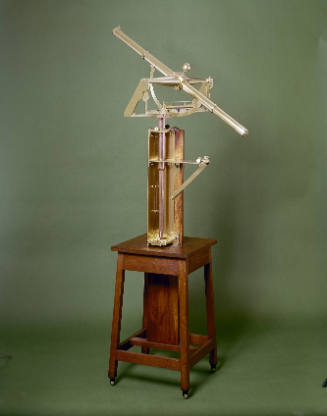
Telescope
Datecirca 1767
Inventory Number0058
ClassificationTransit
Subject
Maker
John Bird
1709 - 1776
User
John Winthrop
1714 - 1779
Cultural Region
Place of Origin
Dimensions175.3 × 53 × 52 cm (69 × 20 7/8 × 20 1/2 in.)
telescope: 4.1 x 4.1 x 99 cm (1 5/8 x 1 5/8 x 39 in.)
telescope: 4.1 x 4.1 x 99 cm (1 5/8 x 1 5/8 x 39 in.)
Material
AccessoriesBase (0058.1)
Bibliography
DescriptionA refracting telescope is mounted on two conical arms that are carried in a cradle. A semicircular divided scale attached beneath the telescope gives the altitude of a star sighted through the telescope. A hanging bubble level is present.
The cradle for the telescope is attached to a vertical column of mahogany that terminates in a brass point. The column slides through holes in a tall, narrow brass frame supported on an upright mahogany plank attached to a mahogany table.
The upper portion of the instrument, from the transit telescope down through the wooden column, is missing. It was stolen when on display in 1979.
The cradle for the telescope is attached to a vertical column of mahogany that terminates in a brass point. The column slides through holes in a tall, narrow brass frame supported on an upright mahogany plank attached to a mahogany table.
The upper portion of the instrument, from the transit telescope down through the wooden column, is missing. It was stolen when on display in 1979.
In Collection(s)
SignedJohn Bird London
Curatorial RemarksThe upper portion of the transit was stolen from the Allston Burr exhibition area in 1979. Only the base remains.
FunctionAn astronomical transit is used with a clock to measure the altitude and time that a star or celestial body crosses the meridian at a specific location. This gives the declination and right ascension of the star, which are that star's coordinates in the sky. The information can also be used to find the longitude of a location if one has knowledge of when the meridian crossing would happen at the zeroth longitude.
If one has a table listing when a particular star is to cross the meridian at a given location, one can use the transit to find the time at that location at that moment. For this reason, small tabletop transits like this one were often used by watchmakers to check the running of their watches and clocks.
Medium-sized and larger portable transits were used in the field by astronomers when they went on expeditions to observe an eclipse or Transit of Venus.
If one has a table listing when a particular star is to cross the meridian at a given location, one can use the transit to find the time at that location at that moment. For this reason, small tabletop transits like this one were often used by watchmakers to check the running of their watches and clocks.
Medium-sized and larger portable transits were used in the field by astronomers when they went on expeditions to observe an eclipse or Transit of Venus.
Historical AttributesOn May 11, 1767, the Harvard Corporation voted its thanks to Thomas Hollis, Esquire, of Lincolns Inn, London for his gift of £200, to be used to enlarge the philosophical apparatus at the College. Some of this money went to purchase this transit by John Bird. Benjamin Franklin acted as Harvard's agent in London. It cost 40 guineas.
Professor John Winthrop used this transit for his observation of the Transit of Venus in 1769.


Barthélémy Urbain Bianchi
Date: 1840-1896
Accessories: 3 brass feet
Object number: DW0815

W. & L. E. Gurley
Date: ca. 1884
Accessories: solar attachment; case; level; green filter; sun shade; tripod (5163b)
Object number: 5163a


John H. Temple
Date: 1850-1870
Accessories: carrying case; dust cap; leather straps; tripod (5166b)
Object number: 5166a


Buff & Buff Manufacturing Company
Date: circa 1910
Accessories: carrying case; sunshades (2); dust cap; trivet; tripod (5177b)
Object number: 5177a

W. & L. E. Gurley
Date: circa 1910
Accessories: carrying case; dust cap; small tool; sunshade; key; plumb bob chain; tripod (5176b)
Object number: 5176a

Buff & Buff Manufacturing Company
Date: circa 1905
Accessories: wood case; leather case; right-angle prism; plumb bob; oil flask; tripod (5174b)
Object number: 5174a

Andrew Yeates
Date: circa 1840
Accessories: case, second eyepiece, plumb bob
Object number: 5235

Parent/Child