


constant variable thread
Date1952-1964
Inventory Number1997-1-1639
ClassificationCalculating Instrument
Subject
Maker
Walter Balcke
Cultural Region
Place of Origin
Place of Use
Dimensions1 x 11 x 4 cm (3/8 x 4 5/16 x 1 9/16 in.)
Material
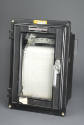
DescriptionThe constant variable thread apparatus consists of two parts. First is a long rectangular spool of clear plexiglass around which the thin sky blue thread is wound. The spool has a rectangular clear plexiglass handle emerging from one side.
The second piece is rectangular shaped, with a round extension on one end. This piece is also constituted of clear plexiglass. A round hole is cut through the extended piece, and framed with blue plexiglass. The blue thread would have been run through this hole. There are four parallel, raised blue plexiglass lines on the top panel of the piece. A rectangular groove is cut the length of the line on the other side of the panel. Three of the lines are together, equally spaced, next to the extension with the hole. Each is labeled by a hand-written black symbol in a white depressed circle inserted partway down each line. The symbols for these three lines, from left to right, are "6", "8", and “1". The fourth line is near the opposite edge of the piece. It too is labeled on a white circle inserted partway down the line and reads "14". There are two additional white circles with symbols. One, right next to the hole in the extension, reads "C". The other is placed in the gap between the three left lines and the fourth rightmost line and it reads "d".
The blue thread can be wound through the hole, and around each of the lines using the back grooves to hold it in place.
The second piece is rectangular shaped, with a round extension on one end. This piece is also constituted of clear plexiglass. A round hole is cut through the extended piece, and framed with blue plexiglass. The blue thread would have been run through this hole. There are four parallel, raised blue plexiglass lines on the top panel of the piece. A rectangular groove is cut the length of the line on the other side of the panel. Three of the lines are together, equally spaced, next to the extension with the hole. Each is labeled by a hand-written black symbol in a white depressed circle inserted partway down each line. The symbols for these three lines, from left to right, are "6", "8", and “1". The fourth line is near the opposite edge of the piece. It too is labeled on a white circle inserted partway down the line and reads "14". There are two additional white circles with symbols. One, right next to the hole in the extension, reads "C". The other is placed in the gap between the three left lines and the fourth rightmost line and it reads "d".
The blue thread can be wound through the hole, and around each of the lines using the back grooves to hold it in place.
Signedunsigned
Curatorial RemarksThat this is one of Balcke's constructions is verified by one of the seven instructional cards in Lib.4927, CHSI library, pertaining to this object.
FunctionWalter Balcke built and gave many mathematical models to the Mathematics department at Harvard University. According to substantial correspondence between mathematics professors and Balcke, the models were sometimes used in classes, circulated around the department for observation, and eventually put on display in the mathematics library.
This particular device is designed for solving certain algebraic equations. It also demonstrates algebraic relations visually. Lib.4927 contains an instruction card that pertains to this object. It reads as follows:
"EQUATION SOLUTION / WITH A 'CONSTANT' VARIABLE AND THREAD / A varying scale permits numbers between / .2 and unity to be represented by a constant / length. A root of fitting quadratic or cubic / equations is indicated through the changing / length of a summarizing thread passing around / moving posts which the mechanism maintains / in the required geometric relation. / The two diagrams show conditions when x is / unity and when it is .5 / OE = OC EC = EF = 2EG = x = 2 inches. / The measuring element reproduces triangle / EOG in a more suitable way and place. The / moving guide-line provides the proper scale. / Coefficients of the second and third de- / gree terms are represented by the number of / strands of thread between the various posts:- / One strand between A & C represents +x^2 / [One strand between] F & C [represents] -x^2 / [One strand between] B & C [represents] +.5x^3 / [One strand between] D & C [represents] -.5x^3 / The coefficient of the first degree term / may be fractional. The algebraic sum of all / coefficients cannot exceed 4, unless by exten - / sion of the guide-line and scale grid. / Example: - 4x - x^2 = 1.8975 / The thread would pass from the binding - / post around E, C, & F and under the small / post projection to the guide-line. With the / spacer locking C & F at 2" and the thread taut, / the adjustable rider is set with its cross- / mark at 3. The rider nut is then tightened / and C is moved toward F until this cross-mark / reaches 1.8975 on the guide-line. The root / is then read at the mark on the guide-line, / two inches below F. The root should be .55 / 4.4x - 1.5x^3 = 1.664 Root is .4 / Starting from D, -C, D, C, E, F / Set rider at 2.9 / 3x - 2x^2 + x^3 = 1.296 Root is .6 / From binding-post- F, C, B, C, F / Set rider at 2. / The effect on the thread length of rolling / or unrolling at posts C and E may often be / avoided by an equivalent arrangement such / as reversing the loop direction at one post. / With the spacer on E and C, its handle may / help in securing smooth operation. / When the thread does not slip freely it / may be necessary to temporarily loosen it / at intermediate points. / The above would be altered somewhat with / a less simple method of starting, through use / of substitutions of less than unity. / Greater accuracy may be obtained by repeat - / ing after setting the rider as indicated by / substitution of the first result."
The instruction card is accompanied by another card with two hand-drawn labeled diagrams. The diagrams are now quite faded and difficult read.
This particular device is designed for solving certain algebraic equations. It also demonstrates algebraic relations visually. Lib.4927 contains an instruction card that pertains to this object. It reads as follows:
"EQUATION SOLUTION / WITH A 'CONSTANT' VARIABLE AND THREAD / A varying scale permits numbers between / .2 and unity to be represented by a constant / length. A root of fitting quadratic or cubic / equations is indicated through the changing / length of a summarizing thread passing around / moving posts which the mechanism maintains / in the required geometric relation. / The two diagrams show conditions when x is / unity and when it is .5 / OE = OC EC = EF = 2EG = x = 2 inches. / The measuring element reproduces triangle / EOG in a more suitable way and place. The / moving guide-line provides the proper scale. / Coefficients of the second and third de- / gree terms are represented by the number of / strands of thread between the various posts:- / One strand between A & C represents +x^2 / [One strand between] F & C [represents] -x^2 / [One strand between] B & C [represents] +.5x^3 / [One strand between] D & C [represents] -.5x^3 / The coefficient of the first degree term / may be fractional. The algebraic sum of all / coefficients cannot exceed 4, unless by exten - / sion of the guide-line and scale grid. / Example: - 4x - x^2 = 1.8975 / The thread would pass from the binding - / post around E, C, & F and under the small / post projection to the guide-line. With the / spacer locking C & F at 2" and the thread taut, / the adjustable rider is set with its cross- / mark at 3. The rider nut is then tightened / and C is moved toward F until this cross-mark / reaches 1.8975 on the guide-line. The root / is then read at the mark on the guide-line, / two inches below F. The root should be .55 / 4.4x - 1.5x^3 = 1.664 Root is .4 / Starting from D, -C, D, C, E, F / Set rider at 2.9 / 3x - 2x^2 + x^3 = 1.296 Root is .6 / From binding-post- F, C, B, C, F / Set rider at 2. / The effect on the thread length of rolling / or unrolling at posts C and E may often be / avoided by an equivalent arrangement such / as reversing the loop direction at one post. / With the spacer on E and C, its handle may / help in securing smooth operation. / When the thread does not slip freely it / may be necessary to temporarily loosen it / at intermediate points. / The above would be altered somewhat with / a less simple method of starting, through use / of substitutions of less than unity. / Greater accuracy may be obtained by repeat - / ing after setting the rider as indicated by / substitution of the first result."
The instruction card is accompanied by another card with two hand-drawn labeled diagrams. The diagrams are now quite faded and difficult read.
ProvenanceFrom the Department of Mathematics, Harvard University.

Walter Balcke
Date: 1955
Accessories: mahogany box with plexiglass lid; pencil; eraser; box of lead; putty ball; cleaning cloth; cardboard instruction card
Object number: 1997-1-1619

Panelvision Corporation
Date: 1984
Accessories: single-board display controller
cable for display (1997-1-0686c)
shipping ticket/ hand carry pass dated June 11, 1997 (in instrument file)
letter to Dr. Richard V. Kollarits from William Andrewes dated June 16, 1997 regarding donation of MiniGraphic display and letter to William Andrewes from Dr. Richard V. Kollarits that accompanied the object upon donation on June 11, 1997 (in instrument file)
four sample color prints made with this display on micro-encapsulated photographic paper. 1. man in business suit, 2. woman crouching next to lawn ornament, 3. two clowns painting a third's face, 4. woman in winter hat and scarf (in instrument file)
copies of two articles by AT&T Bell Laboratories staff (Richard V. Kollarits, William, H. Ninke, David C. Gibbon) on color imaging and printing (in instrument file)
Panelvision pamphlet introducing the MiniGraphic multipurpose flat panel display, including instrument specifications, consumer prices, functioning and features (in instrument file)
1984 article by Panelvision employees (Peter Brody Fang-Chen Luo, Paul Malmberg) on active matrix technology (in instrument file)
Panelvision Corporation Fact Sheet, including details of company history and recent developments (in instrument file)
article about commercial debut of active matrix technology from Design Engineering newspaper, June 18, 1984 (in instrument file)
full circuit diagram and schematic for MiniGraphic Display Controller (in instrument file)
instruction manual and description of MiniGraphic Display Controller (two copies, in instrument file)
circuit diagrams and instruction manuals for the MiniGraphic Display (two booklets, in instrument file)
Object number: 1997-1-0686a

Walter Balcke
Date: 1952-1964
Accessories: mahogany box; cardboard instruction card
Object number: 1997-1-1601

Walter Balcke
Date: circa 1958
Accessories: in library folder (Lib 4927):
-twenty-one letters from Joseph L. Walsh, mathematics professor at Harvard University, to Walter Balcke, dated between 27 May 1957 and 24 January 1964 (letters thank Balcke for the many mathematical models he gifted to the Mathematics Department, praise his skill and ingenuity, many invite him to faculty and personal luncheons, and one letter provides an analytic solution to the "13-point problem" behind one of Balcke's models)
-three letters from Garret Birkhoff (then Chairman of the Harvard Mathematics Department) dated 3 March 1954, 4 January 1955, and 10 January 1955, each expressing gratitude (and in one case, an official department thank you) for the many mathematical models he gifted to the mathematics department
-photocopy of original envelope in which correspondence between mathematics department and Walter Balcke was stored (original was destroyed on 13 July 1997)
-photocopy of instructional card for object 1997-1-1671
- seven instructional cards that accompany the following Balcke models: Pascal's Theorem, Brianchon's Concurrent Lines, Trisector, Twelve Point Ellipse, Rolling Parabola, unknown, Equation Solution with a 'Constant' Variable and Thread
- photograph of the display case containing Balcke's models in the Harvard Mathematics department
Object number: 1997-1-1597

Walter Balcke
Date: 1952-1964
Accessories: mahogany case; two circular protractors; clear plexiglass rule with serated edge
Object number: 1990-5-0028


Walter Balcke
Date: 1953
Accessories: mahogany box; cardboard instruction card;
in library folder (Lib 4927):
-twenty-one letters from Joseph L. Walsh, mathematics professor at Harvard University, to Walter Balcke, dated between 27 May 1957 and 24 January 1964 (letters thank Balcke for the many mathematical models he gifted to the Mathematics Department, praise his skill and ingenuity, many invite him to faculty and personal luncheons, and one letter provides an analytic solution to the "13-point problem" behind one of Balcke's models)
- one letter from J.L. Walsh directly related to this object, the "modified slide rule", dated February 11, 1953
-three letters from Garret Birkhoff (then Chairman of the Harvard Mathematics Department) dated 3 March 1954, 4 January 1955, and 10 January 1955, each expressing gratitude (and in one case, an official department thank you) for the many mathematical models he gifted to the mathematics department
-photocopy of original envelope in which correspondence between mathematics department and Walter Balcke was stored (original was destroyed on 13 July 1997)
-photocopy of instructional card for object 1997-1-1671
- seven instructional cards that accompany the following Balcke models: Pascal's Theorem, Brianchon's Concurrent Lines, Trisector, Twelve Point Ellipse, Rolling Parabola, unknown, Equation Solution with a 'Constant' Variable and Thread
- photograph of the display case containing Balcke's models in the Harvard Mathematics department
Object number: 1997-1-1609

Walter Balcke
Date: 1962
Object number: 1997-1-1649

Jakob Amsler
Date: circa 1906
Accessories: instrument is in four (4) parts; the rail is in own box and is inventory # 2006-1-0002b; letter from Prof. William Brower containing the complete history of ownership and use (missing)
Object number: 2006-1-0002a

Gebrüder Haff
Date: 1960-1969
Accessories: plush-lined, hard green case
white card with instrument information in case
Object number: 1999-1-0005

Walter Balcke
Date: 1953
Accessories: mahogany box; cardboard instruction card;
in library folder (Lib 4927):
-twenty-one letters from Joseph L. Walsh, mathematics professor at Harvard University, to Walter Balcke, dated between 27 May 1957 and 24 January 1964 (letters thank Balcke for the many mathematical models he gifted to the Mathematics Department, praise his skill and ingenuity, many invite him to faculty and personal luncheons, and one letter provides an analytic solution to the "13-point problem" behind one of Balcke's models)
- one letter from J.L. Walsh pertains directly to this object, dated October 27, 1953
-three letters from Garret Birkhoff (then Chairman of the Harvard Mathematics Department) dated 3 March 1954, 4 January 1955, and 10 January 1955, each expressing gratitude (and in one case, an official department thank you) for the many mathematical models he gifted to the mathematics department
-photocopy of original envelope in which correspondence between mathematics department and Walter Balcke was stored (original was destroyed on 13 July 1997)
-photocopy of instructional card for object 1997-1-1671
- seven instructional cards that accompany the following Balcke models: Pascal's Theorem, Brianchon's Concurrent Lines, Trisector, Twelve Point Ellipse, Rolling Parabola, unknown, Equation Solution with a 'Constant' Variable and Thread
- photograph of the display case containing Balcke's models in the Harvard Mathematics department
Object number: 1997-1-1610