


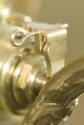


air pump
Date1745-1749
Inventory Number3002
ClassificationAir Pump
Subject
Attributed to
Abbé Jean-Antoine Nollet
1700 - 1770
Cultural Region
Place of Origin
Dimensions171 x 61 x 54 cm (67 5/16 x 24 x 21 1/4 in.)
Material
Bibliography
DescriptionSupported by three curved legs, this air pump is made of only one brass cylinder (which Nollet thought was better than having two). To make the piston go up and down the cylinder, one used both a hand (on the handle, to pull up) and a foot (in the stirrup, to push down) to maneuver the specially designed pump handle.
A big wheel on the side of the instrument is used to put into movement a set of pulleys connected to the top of the instrument's frame. It was used especially for fire and electrical experiments. Instead of a bell jar, a pair of Magdeburg hemispheres is fixed in its place. Below the brass supporting plate is the stopcock that controls the flow of air between the pump and the bell jar (or Magdeburg hemispheres). On the opposite side of the bronze stopcock, a smaller pressure valve is used to introduce tiny amounts of air inside the same closed space.
The whole instrument is decorated with verni martin.
A big wheel on the side of the instrument is used to put into movement a set of pulleys connected to the top of the instrument's frame. It was used especially for fire and electrical experiments. Instead of a bell jar, a pair of Magdeburg hemispheres is fixed in its place. Below the brass supporting plate is the stopcock that controls the flow of air between the pump and the bell jar (or Magdeburg hemispheres). On the opposite side of the bronze stopcock, a smaller pressure valve is used to introduce tiny amounts of air inside the same closed space.
The whole instrument is decorated with verni martin.
In Collection(s)
Signedunsigned
Curatorial RemarksThe punched c-crown on the bronze pieces on this instrument was a mark expressing the fact that a special tax on these materials had been paid. The 1745 royal <i>édit</i> required that all the old and new manufactured goods made in copper, and all of its alloys, be looked at and stamped. It was an obligation that lasted until 1749. It is from this information that this air pump was dated. It is one of the very few instruments in Nollet style that we are sure was made during Nollet's lifetime.
FunctionAn air-pump is an instrument used to produce a vacuum in order to study nature under controlled environmental conditions. It became one of the most important scientific instruments of natural philosophy as early as the late seventeenth century. With the electrostatic machine, the air-pump became in time not only a genuine research tool but an important pedagogical apparatus in the lecturer-demonstrator's arsenal.
ProvenanceDavid P. Wheatland, Topsfield, MA.




John Cuthbertson
Date: 1770-1815
Accessories: brown storage box, descriptive tag, thin strip of paper in box with the inscription "lucernal microscope" in David P. Wheatland's handwriting (which refers to figs. 47-48 and 51 in this series), page from the book "Old Science and Medicine" with a photographic copy of the first print from this series, entitled "The Large Electric Machine at Haarlem."
Object number: 1998-1-1087