


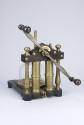


double-barreled air pump
Datecirca 1770
Inventory NumberDW0893
ClassificationAir Pump
Subject
Maker
Benjamin Martin
1704 - 1782
Cultural Region
Place of Origin
Dimensions30.7 × 42 × 40.5 cm (12 1/16 × 16 9/16 × 15 15/16 in.)
Material
Accessoriesbell jar
Credit LineGift of David P. Wheatland
Bibliography
DescriptionThis air pump is made of two pistons encompassed in brass cylinders (or barrels). The pistons are moved by a long steel crankshaft ended by two wood handles. The pistons and crankshaft are held in place by two turned brass columns, linking the base of the air pump to the top molding. The stopcock, which allows air in and out of the bell jar, is positioned at the front of the rectangular wooden base.
As Martin says himself: "The Simplicity of this New Form of a double barrelled Pump, is manifestly the greatest that can be, because it contains nothing more than the Head or Frame of the two Barrels; and the Basis, or Bottom on which the Receivers are placed; and that it cannot have a less Number of Parts than these two, is self-evident." (p.2)
In one of Benjamin Martin's price list catalogues, he mentions: "A new Portable Air-Pump, exclusive of any Apparatus, 6 [l.] 6 [s.]". To see the whole array of "Apparatus" that Martin could offer, see his publication on the air pump.
As Martin says himself: "The Simplicity of this New Form of a double barrelled Pump, is manifestly the greatest that can be, because it contains nothing more than the Head or Frame of the two Barrels; and the Basis, or Bottom on which the Receivers are placed; and that it cannot have a less Number of Parts than these two, is self-evident." (p.2)
In one of Benjamin Martin's price list catalogues, he mentions: "A new Portable Air-Pump, exclusive of any Apparatus, 6 [l.] 6 [s.]". To see the whole array of "Apparatus" that Martin could offer, see his publication on the air pump.
In Collection(s)
Signedon brass plate, engraved: B. MARTIN LONDON Inv.'t
FunctionAn air-pump is an instrument used to produce a vacuum (or large pressures) in order to study nature under controlled environmental conditions. It became one of the most important scientific instruments of natural philosophy as early as the late seventeenth century. With the electrostatic machine, the air-pump became in time not only a genuine research tool but an important pedagogical apparatus in the lecturer-demonstrator's arsenal.
To understand how this one worked, take a look at the video attached to this instrument.
To understand how this one worked, take a look at the video attached to this instrument.
ProvenanceDavid P. Wheatland purchased from Alain Brieux, Paris, April 19, 1962 (lot 5/2).


Percy Williams Bridgman
Date: circa 1938
Accessories: one bolt protector; one attachment; two large bolts, black and white photographs (C6-G1). Parts can be found in drawer B11-I8. Bridgman Press Manual (copy) in instrument file folder
Object number: 1997-1-1819a


Percy Williams Bridgman
Date: 1924-1937
Accessories: cardboard box of spare parts; rubber tube; yellow hand pump; metal wire; torque wrench; wrenches (3); 1 CD; 1 audio cassette; 1 user's manual; 1 graph
Object number: 2004-1-0404
Percy Williams Bridgman
Date: 1924-1937
Object number: 2004-1-0404.1
Percy Williams Bridgman
Date: 1924-1937
Object number: 2004-1-0404.2
Percy Williams Bridgman
Date: 1924-1937
Accessories: two boxes of parts/tools for bridgman press (.1 & .2)
Object number: 2004-1-0404.3


