


air pump
Datecirca 1850
Inventory Number1997-1-0297
ClassificationAir Pump
Subject
Maker
Edward Samuel Ritchie
1814 - 1895
User
Department of Geology and Geography, Harvard University
1890 - 1961
Cultural Region
Place of Origin
Dimensions106 x 83.6 x 52.3 cm (41 3/4 x 32 15/16 x 20 9/16 in.)
Material
Bibliography
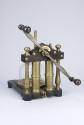
DescriptionThe large air pump consists of a single barrel on top of which a long rod connects the piston to the lever. The latter is supported by a two short turned columns fixed on top of the frame. There is also a small mercury cup (to prevent air leakage) and a short brass cylinder on the barrel. Once the latter has been removed, a barometer and siphon gauge could be added to the pump (missing here). The barrel is connected to a brass tube to the vacuum plate situated on top of the frame. A stopcock, on the vertical section of the tube, controls the flow of air to the plate. Sitting on top of the brass plate, covered in glass, is a glass bell. The whole apparatus is found in by a sturdy mahogany frame supported by four turned feet.
Signedon plaque, top board: E. S. RITCHIE / BOSTON, MASS.
FunctionAn air-pump is an instrument used to produce a vacuum in order to study nature under controlled environmental conditions. It became one of the most important scientific instruments of natural philosophy as early as the late seventeenth century. With the electrostatic machine, the air-pump became in time not only a genuine research tool but an important pedagogical apparatus in the lecturer-demonstrator's arsenal. Ritchie, as most instrument makers, sold several kinds of these, ranging in price from $25 to $300. This was is masterpiece, which he sold $300 in 1855.
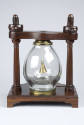
In this model, a glass bell jar has been put on the plate. The experiments would have taken place inside the bell jar.
This is how Ritchie introduced his air pumps in 1855: "As so many experiments depend on the perfection of this instrument, I have spared no expense in my machinery for making every part in the most perfect manner. I have introduced some improvements in its construction. My pumps are made on the principle of Leslie, but much improved."
In this model, a glass bell jar has been put on the plate. The experiments would have taken place inside the bell jar.
This is how Ritchie introduced his air pumps in 1855: "As so many experiments depend on the perfection of this instrument, I have spared no expense in my machinery for making every part in the most perfect manner. I have introduced some improvements in its construction. My pumps are made on the principle of Leslie, but much improved."
ProvenanceFrom the Department of Geology and Geography, Harvard University.




See also/See also
