


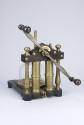
air pump base
Date1870-1890
Inventory Number1998-1-0131
ClassificationAir Pump
Subject
Maker
E. S. Ritchie & Sons
founded 1867
User
Blue Hill Meteorological Observatory
1885-present
Cultural Region
Place of Origin
Place of Use
Dimensions19.8 × 20.3 × 31 cm (7 13/16 × 8 × 12 3/16 in.)
Material
Bibliography
DescriptionA rectangular thick wooden mahogany board is supported by four turned feet. On top of the board is a vacuum plate in brass, the center of which linked by a tube to where a hand pump would have been screwed in. On the brass plate has been added a tube with stopcock connected to another glass plate, on which was performed the vacuum experiments. On the small wood block, linking the attached hand pump to the bottom brass plate, is a knob on top and a hole diagonally (another slot for the pump).
Signedon plaque: E.S. RITCHIE & SONS. / BOSTON
Curatorial RemarksThis instrument came with a card that reads: "MASSACHUSETTS INSTITUTE OF TECHNOLOGY LIBRARIES / VACUUM BELL JAR / c. 1840 Hand vacuum pumps and appertinences of all sorts were widely used at this time in physics and chemistry. The Boston Suppliers of scientific apparatus became the leaders in the field!"
FunctionThis vacuum plate was likely used with a pump similar to 1998-1-0148. The latter could have been put upright (where the knob is now) or diagonally, where a hole is seen.
An air-pump is an instrument used to produce a vacuum in order to study nature under controlled environmental conditions. It became one of the most important scientific instruments of natural philosophy as early as the late seventeenth century. With the electrostatic machine, the air-pump became in time not only a genuine research tool but an important pedagogical apparatus in the lecturer-demonstrator's arsenal. Ritchie, as most instrument makers, sold several kinds of these, ranging in price from $10 to $300. This one was $10.
In this model, a glass bell jar would have been put on the top glass plate. The experiments would have taken place inside the bell jar.
An air-pump is an instrument used to produce a vacuum in order to study nature under controlled environmental conditions. It became one of the most important scientific instruments of natural philosophy as early as the late seventeenth century. With the electrostatic machine, the air-pump became in time not only a genuine research tool but an important pedagogical apparatus in the lecturer-demonstrator's arsenal. Ritchie, as most instrument makers, sold several kinds of these, ranging in price from $10 to $300. This one was $10.
In this model, a glass bell jar would have been put on the top glass plate. The experiments would have taken place inside the bell jar.
ProvenanceFrom the Blue Hill Meteorological Observatory.




See also/See also
