


control hammer
Date1880-1920
Inventory Number1998-1-0139
ClassificationControl Hammer
Subject
Maker
American
Cultural Region
Dimensions8.4 x 18 x 11.4 cm (3 5/16 x 7 1/16 x 4 1/2 in.)
Material
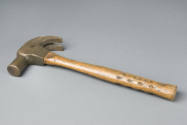
DescriptionThe base of this instrument consists of several electrical connectors, controlling the hammer and linking it to other instruments. The hammer is made to strike the anvil at one end of the base, which produced a sound used in reaction-time experiments. (The hammer's counterweight is missing here.) An electromagnet is used to release the hammer. The thumb screw at the top adjusts the height of the hammer over the anvil before it is being released. The higher the hammer, the louder the sound will be.
The number "4" is stamped on the base.
The number "4" is stamped on the base.
Signedunsigned
FunctionThe Control Hammer was invented to calibrate the Hipp Chronoscope along with the Gravity Chronometer and the Pendulum Chronometer. It was designed to produce an absolutely accurate interval of time between opening its electrical contacts and closing them.
The control hammer apparatus consists of a bent lever whose arm is heavily weighted and turns about a horizontal axis. As the hammer-head descends, a cross bar on the shank makes or breaks the electrical contacts. An electromagnet releases the hammer and it falls past one electrical contact which opens the circuit to the Hipp Chronoscope, engaging its clutch and starting it measuring time. When the hammer falls past a second electrical contact, the circuit is closed, which makes the clutch on the Hipp Chronoscope disengaged and as a result stops its dial from moving. The control hammer is supposed to provide an absolutely reliable time interval which could be used to calibrate and check on the operation of the Hipp Chronoscope. The control time is varied by shifting the counterweight on the short arm of the lever.
Unfortunately, the control hammer itself needed to be calibrated. In order to know exactly how long the constant interval provided by the control hammer was, a chronograph that accurately measures extremely small time intervals was needed.
(This text was taken verbatim from this website.)
The control hammer apparatus consists of a bent lever whose arm is heavily weighted and turns about a horizontal axis. As the hammer-head descends, a cross bar on the shank makes or breaks the electrical contacts. An electromagnet releases the hammer and it falls past one electrical contact which opens the circuit to the Hipp Chronoscope, engaging its clutch and starting it measuring time. When the hammer falls past a second electrical contact, the circuit is closed, which makes the clutch on the Hipp Chronoscope disengaged and as a result stops its dial from moving. The control hammer is supposed to provide an absolutely reliable time interval which could be used to calibrate and check on the operation of the Hipp Chronoscope. The control time is varied by shifting the counterweight on the short arm of the lever.
Unfortunately, the control hammer itself needed to be calibrated. In order to know exactly how long the constant interval provided by the control hammer was, a chronograph that accurately measures extremely small time intervals was needed.
(This text was taken verbatim from this website.)


H. Sumner
Date: circa 1903
Accessories: wooden disks (41); steel and brass fittings; wooden box for storing accessories
Object number: WJ0112



Massachusetts Charitable Mechanic Association
Date: dated 1856
Accessories: black leather case with maroon velvet lining
Object number: 1998-1-1356

Massachusetts Charitable Mechanic Association
Date: dated 1869
Accessories: leather case lined with tan velvet
Object number: 1998-1-1359


Wessell, Nickel & Gross
Date: circa 1910
Object number: 1997-1-1064

T. H. Letcher
Date: circa 1889
Accessories: a bottle of barium hydroxide (4510a) may have been part this set.
Object number: 4510b


John Pass
Date: 1815
Object number: 1998-1-1642